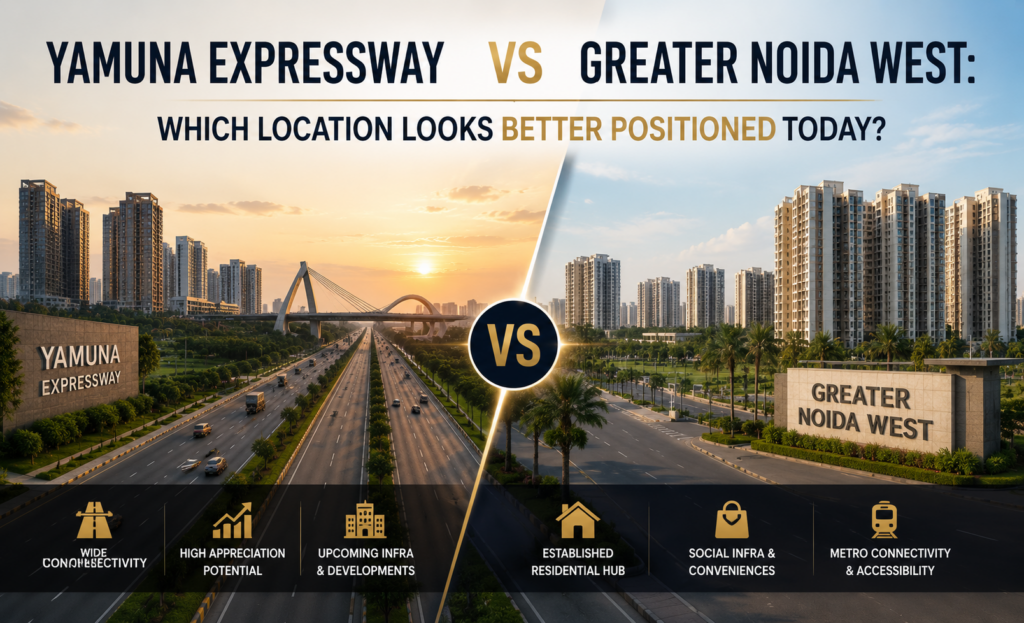
If you are comparing Yamuna Expressway vs Greater Noida West, the short answer is this: Greater Noida West currently looks stronger for end use, rental demand and lower execution risk, while Yamuna Expressway may suit buyers who can wait for infrastructure-led value creation. Which one is better depends less on headline buzz and more on your holding period, income strategy and tolerance for uncertainty.
That distinction matters because these two corridors are often discussed as if they are competing versions of the same market. They are not. Greater Noida West is already a functioning residential belt with active housing stock, daily-use infrastructure and established occupancy. Yamuna Expressway, by contrast, is a much larger long-horizon growth story linked to regional connectivity and airport-led development. Both have merit, but they serve different buyer profiles.
For first-time buyers and many end users, the practical question is simple: where can you live comfortably, commute reasonably and see stable demand? For investors, the sharper question is: where is the balance between current demand and future upside more favourable today? Based on the available evidence, one corridor is indeed pulling ahead for present-day livability, while the other remains a higher-conviction future play.
Quick verdict: which location may deliver better returns?
If by “returns” you mean a combination of occupancy, resale liquidity and less speculative risk, Greater Noida West appears better placed today. Research in the supplied material repeatedly describes it as a fully functional residential area with schools, hospitals, retail and rental demand already in place. That tends to support steadier real demand rather than purely expectation-driven pricing.
If by “returns” you mean long-term capital appreciation from major infrastructure transformation, Yamuna Expressway could still outperform over a longer holding period, but that view depends on project execution, absorption and how quickly jobs, social infrastructure and end-user demand deepen around the corridor. It should therefore be treated as a possibility, not a certainty.
In plain terms:
- Choose Greater Noida West if you want a home soon, rental visibility, broader daily convenience and more mature market behaviour.
- Consider Yamuna Expressway if you are a patient investor, can handle a longer wait and are specifically targeting future infrastructure-led growth themes.
Why Greater Noida West is ahead on current fundamentals
Greater Noida West has one major advantage that is difficult to ignore: it already functions as a residential ecosystem. The supplied research points to active demand for rentals and existing social infrastructure, including schools, hospitals and retail. For real estate, that matters because end-user depth usually supports more resilient pricing than a market driven mainly by future announcements.
It also benefits from its position within the larger Noida-Greater Noida urban network. The Noida-Greater Noida Expressway is an established regional connector, and this broader urban continuity tends to improve commute options, services and market activity over time. Buyers can assess actual neighbourhood life instead of buying largely on projection.
For investors, that means three practical strengths:
- Rental demand is easier to evaluate because there are occupied projects and established catchments.
- Resale discovery is clearer because more transactions happen in live communities.
- Execution risk is relatively lower than in a corridor where value depends heavily on future build-out.
This does not mean every micro-market in Greater Noida West is equal. Project quality, maintenance, density, access roads and surrounding civic conditions still vary. But as a corridor, it is easier to underwrite because there is visible on-ground usage.
Why Yamuna Expressway still attracts serious attention
Yamuna Expressway has scale, strategic visibility and a strong infrastructure narrative. The expressway itself is an access-controlled corridor of about 165.5 km linking Greater Noida with Agra, and it has long been central to the region’s expansion logic. Supplied material also notes that the Noida-Greater Noida Expressway is being expanded in the direction of the Taj Economic Zone, the proposed international airport and aviation hub along the Yamuna belt, reinforcing the corridor’s long-range importance.
The investment case here is straightforward: large transport infrastructure can reshape land values and create new demand clusters over time. Additional evidence in the research refers to direct airport access themes, industrial planning and broader connectivity improvements, all of which can improve the corridor’s attractiveness if delivered and absorbed well.
There is also mention of a proposed 130-metre-wide road intended to connect Greater Noida West with Yamuna City over roughly 25 km, with media reporting suggesting completion is expected by 2026. That is potentially meaningful because stronger cross-linkages can reduce the sense that these are isolated growth pockets. However, as with any under-construction or proposed infrastructure, buyers should independently verify current status before making decisions.
The caution is equally important: infrastructure-led corridors can price in future expectations well before surrounding liveability catches up. That can still work out well for patient buyers, but timing becomes critical. If absorption is slower than expected, holding periods can stretch.
Connectivity comparison: present convenience vs future potential
| Factor | Greater Noida West | Yamuna Expressway |
|---|---|---|
| Current urban integration | Stronger; part of an active residential network linked to Noida and Greater Noida | Selective; stronger on corridor-scale movement than on uniformly mature urban fabric |
| Daily commute practicality | Generally better for current residents, subject to specific sector and road conditions | Can be efficient for long-distance travel, but live-work convenience depends heavily on exact location |
| Regional infrastructure story | Incremental strengthening through urban expansion and proposed connectors | Very strong long-term narrative tied to expressway-led and airport-linked development |
| Ease of evaluating neighbourhood quality | Higher, because many pockets are already inhabited and operational | Lower in emerging stretches where future development is still taking shape |
For most end users, current convenience usually beats future convenience. A well-connected lived-in area often wins over a high-potential corridor if the buyer needs predictable commuting, schooling and everyday services soon.
Appreciation outlook: what seems more realistic?
It is risky to claim any location will deliver better returns, because pricing depends on supply, sentiment, execution and affordability cycles. But a reasonable framework is to separate base-case appreciation from upside-case appreciation.
Greater Noida West: stronger base case
The base case in Greater Noida West looks more visible because the area already has occupancy and utility. Appreciation here may be supported by gradual infrastructure improvements, end-user demand and continued urban consolidation. This tends to produce a steadier profile, though not necessarily dramatic upside.
Yamuna Expressway: stronger upside case, higher uncertainty
The upside case on Yamuna Expressway could be larger if airport-linked, industrial and road connectivity themes translate into sustained real demand. But that path usually comes with more variables: delivery timelines, job creation, social infrastructure, developer execution and the pace at which buyers shift from investor interest to genuine occupation.
So, for investors deciding between the two:
- Greater Noida West may offer a more observable appreciation pathway.
- Yamuna Expressway may offer a more asymmetrical long-term thesis, but with more uncertainty around timing and depth of demand.
Rental potential: a major differentiator
This is where the gap is clearer. The supplied evidence explicitly points to rental demand in Greater Noida West and identifies it as a fully functional residential area. That makes it easier for landlords to assess tenant profiles, occupancy trends and real-world livability.
Yamuna Expressway may see rental growth over time as employment nodes and airport-related ecosystems mature, but in many parts the story is still developing. For buyers whose thesis depends on immediate leaseability, that difference is significant.
If rental income matters to you, Greater Noida West is usually the easier market to analyse. If you need help assessing occupancy-led options rather than only brochure-stage narratives, services such as rent or leasing support can help evaluate what is actually moving in the market.
Who should choose which location?
Greater Noida West may suit you if:
- You are a first-time buyer who wants a usable home environment.
- You value schools, hospitals, shops and current community life.
- You want stronger visibility on rentals and resale liquidity.
- You prefer lower dependence on future infrastructure execution.
Yamuna Expressway may suit you if:
- You are comfortable with a longer investment horizon.
- You are specifically targeting infrastructure-led growth corridors.
- You understand that timelines and price discovery may be less predictable.
- You can evaluate micro-location risks instead of buying only on the corridor name.
Actionable checks before you buy in either corridor
- Visit at two different times of day. A fast road on paper can feel very different during peak commute hours.
- Check actual occupancy, not just possession claims. A delivered tower is not the same as a functioning community.
- Map schools, hospitals, grocery and work hubs within realistic travel time. This matters especially for end users.
- Ask about maintenance quality and resident density. These affect rental demand and resale appeal.
- Verify infrastructure status independently. Treat proposed links, roads and regional projects as supportive only after confirmation.
- Compare micro-markets, not just corridors. One strong pocket can outperform a weaker project in a “hot” location.
- Study supply pipelines. Heavy future inventory can influence pricing power and leasing speed.
Final take
In the debate over Yamuna Expressway vs Greater Noida West, Greater Noida West currently appears to be ahead for buyers who value present-day usability, rental demand and a more established residential environment. That makes it the more straightforward choice for many end users, first-time buyers and investors seeking a market they can judge on current fundamentals.
Yamuna Expressway remains one of NCR’s most important future-facing corridors, and it may reward patient buyers if infrastructure, employment and urban services deepen as expected. But its case is still more dependent on execution and time.
So the better location is not universal. It depends on whether you want certainty today or possibility tomorrow. At this stage, Greater Noida West looks stronger on the first count; Yamuna Expressway remains compelling on the second.
Frequently asked questions
Which is better for end use: Yamuna Expressway or Greater Noida West?
For most end users, Greater Noida West appears more practical today because it already has occupied housing, retail and social infrastructure. Yamuna Expressway may improve further over time, but many buyers there are still relying more on future development than current livability.
Is Yamuna Expressway better for long-term appreciation?
It may be, especially if airport-linked and regional infrastructure themes continue to strengthen the corridor. However, that is still a forward-looking view and depends on execution, absorption and the pace of real end-user demand.
Which corridor has stronger rental potential right now?
Greater Noida West appears stronger at present because the area is already functioning as a residential market with visible rental demand. Yamuna Expressway could develop a deeper rental base later, but that may vary widely by micro-location.
Should first-time buyers avoid speculative corridors?
Not necessarily, but first-time buyers should be careful if their plan depends on near-term occupancy, commuting convenience or rental support. In such cases, a more established area is often easier to evaluate than a corridor driven mainly by future expectations.
Sources checked
Send us your property requirement
Prefer not to call? Complete the form and the Aditya Estates team will contact you.