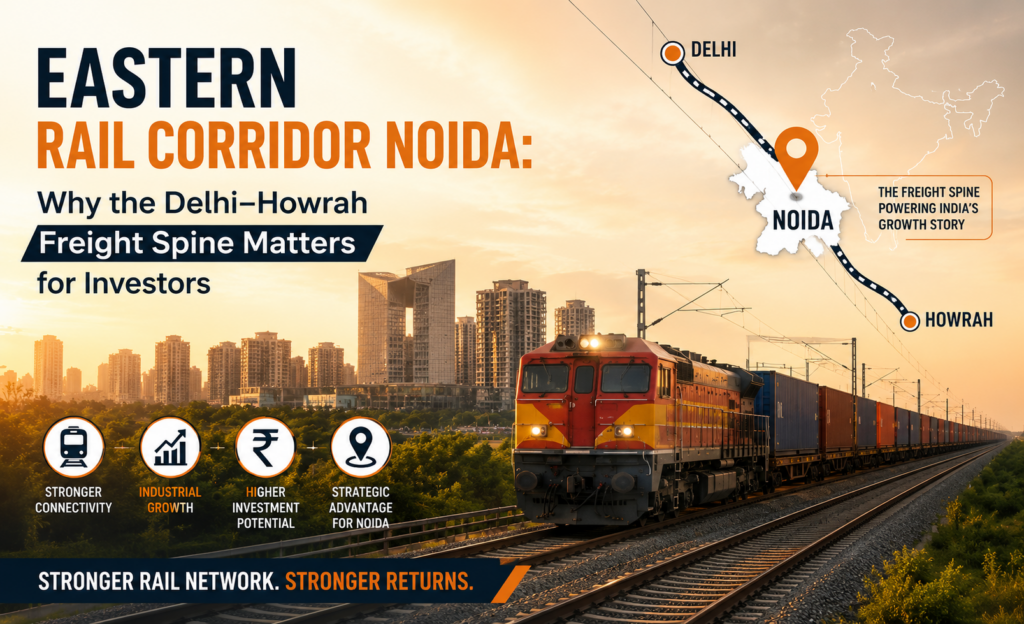
Short answer: the Eastern Rail Corridor Noida story matters because the Delhi–Howrah freight spine can improve cargo movement around the Noida–Dadri–Greater Noida belt, where warehousing, manufacturing support and multimodal logistics infrastructure are already part of the planning ecosystem. For industrial and land-focused investors, this is less about passenger convenience and more about freight efficiency, network effects and location quality.
That distinction is important. Residential buyers often track metro lines and expressways first. Industrial investors, by contrast, usually look for three things: how goods enter and leave a cluster, whether the location links well with highways and ports, and whether policy-backed logistics infrastructure is visible on the ground. On those parameters, the Noida/Dadri side of NCR has attracted attention because it sits close to major road links and to rail-based freight infrastructure associated with the eastern freight route.
This guide explains what is confirmed, what is still developing, and what investors should actually verify before taking exposure to logistics-led micro-markets.
What the corridor is, and why Noida investors should care
India’s dedicated freight corridor programme was conceived to shift freight onto purpose-built railway lines so cargo trains can move faster and more efficiently than on mixed-use passenger routes. The eastern corridor links the north with the east, and the Delhi-region interface is relevant for NCR because freight-linked nodes around Ghaziabad, Dadri and Greater Noida can benefit from improved rail logistics.
For Noida investors, the significance is indirect but potentially meaningful:
- Industrial occupiers often prefer locations with stronger outbound cargo connectivity.
- Warehousing and third-party logistics operators value multimodal access rather than road-only dependency.
- Ancillary businesses such as packaging, cold-chain support, fleet services and worker housing can cluster around logistics corridors.
- Land values in industrial belts may respond over time to real utility, but the pace depends on execution, zoning and occupier demand.
In plain terms, the freight corridor is crucial because it supports the backend economy. It may not change a family’s daily commute, but it can influence where factories, warehouses and distribution operators choose to locate.
How the Noida–Dadri–Ghaziabad belt fits into the logistics map
The Noida side of NCR does not operate in isolation. It is part of a broader logistics geography that includes expressways, industrial townships, rail links and airport-led development. Evidence from public reporting and planning documents points to a few important anchors.
1) Dadri and Greater Noida already sit in a logistics-oriented zone
Techno-feasibility material linked to the Multi Modal Logistics Hub (MMLH) at Greater Noida under the Delhi–Mumbai Industrial Corridor framework describes the wider region as well connected by road and rail, with industrial activity in Noida and Ghaziabad providing a natural demand base. That matters because logistics hubs tend to work best where infrastructure and industry reinforce each other.
Separately, reported coverage has stated that the proposed logistics hub in Greater Noida is to be located next to the Delhi–Howrah railway line and near NH-91, underscoring the role of rail-road integration in site selection.
2) Freight connectivity is stronger when paired with highways
Rail alone rarely creates a logistics hotspot. Cargo needs first-mile and last-mile movement by road. The Noida–Greater Noida side already benefits from major expressway and highway links, and investors should read the freight corridor in combination with those road networks rather than as a standalone trigger.
3) Airport connectivity could widen the regional logistics proposition
Reports indicate that new rail links have been planned to connect the Noida airport area with existing routes, including routes that interface with the eastern freight system. While this does not automatically convert every nearby parcel into a winner, it does suggest a broader logistics ambition for the region: rail, road and airport cargo ecosystems feeding into one another over time.
What is confirmed, and what should be treated cautiously
Investors often mix together passenger rail, freight rail and proposed corridors. That can lead to flawed assumptions. Here is a cleaner way to read the landscape.
| Topic | What appears supported by evidence | How to interpret it |
|---|---|---|
| Eastern freight corridor concept | Dedicated freight corridors are designed for freight-only rail movement, intended to improve efficiency and speed for cargo. | This is a structural logistics reform, not a neighbourhood-level passenger mobility project. |
| Noida/Dadri logistics relevance | Greater Noida logistics hub planning and reports linking it to the Delhi–Howrah line support the region’s freight significance. | Positive for industrial positioning, subject to execution and occupier uptake. |
| RRTS and Namo Bharat proposals | NCRTC and related reports discuss several regional rapid transit corridors, including corridors touching Noida and Ghaziabad. | Useful for regional mobility context, but separate from freight economics. |
| Airport rail linkage discussions | Public reports mention planned links connecting the Noida airport area with existing rail routes. | Potentially important for future multimodal logistics, but investors should verify timelines independently. |
The key takeaway is simple: do not confuse passenger rail announcements with freight-driven industrial demand. They can complement each other, but they are not the same investment thesis.
Why industrial investors track freight corridors differently from residential buyers
If you are evaluating industrial land, logistics parks, warehouses or even commercial support assets, your checklist should differ from a standard residential approach.
Freight corridors can improve operating economics
Where rail freight becomes more efficient, businesses may benefit through better network reliability, potentially lower turnaround constraints, and stronger linkages to distant consumption and production centres. That does not mean every occupier sees identical gains, but it does increase the appeal of locations that can plug into multimodal supply chains.
Cluster effects matter more than the corridor itself
A freight line passing through a region is not enough. Investors should ask whether the surrounding area has:
- Industrial zoning or permitted logistics use
- Road access suitable for heavy vehicle movement
- Availability of power, water and labour catchments
- Presence of anchor occupiers or nearby industrial estates
- Evidence of warehousing or manufacturing absorption
In other words, the corridor can be an enabler. The cluster still has to perform.
Land stories can run ahead of fundamentals
Because infrastructure headlines create excitement, speculative pricing often appears before actual utility is visible. Investor discipline matters. A rail-linked micro-market can still underperform if access roads remain weak, approvals are delayed, or occupier demand stays thin.
Actionable checks before investing near the Eastern Rail Corridor Noida zone
For a top-of-funnel investor, the most useful next step is not to chase a headline, but to verify the operating logic of the location. Use this practical checklist.
- Map the exact asset to freight infrastructure. “Near Dadri” or “near Noida” is too vague. Measure the actual distance to rail-linked logistics facilities, industrial sectors and heavy-vehicle routes.
- Check land use and approvals. Confirm whether the parcel or building is approved for industrial, warehousing, commercial or mixed use, as applicable.
- Study truck access. Visit at different times of day. A theoretically strategic site can lose appeal if turning radii, local congestion or village bottlenecks affect truck movement.
- Review occupier ecosystem. Look for existing warehouses, manufacturers, suppliers or logistics operators nearby. Functioning ecosystems are usually more informative than marketing brochures.
- Separate announced plans from active execution. If a project is proposed, sanctioned or under study, treat each stage differently. Timelines can change.
- Assess utility readiness. Industrial users often ask about power reliability, drainage, internal roads and loading/unloading conditions before rent or sale price.
- Stress-test your exit thesis. Ask who the likely next buyer or tenant is: a warehouse operator, SME manufacturer, institutional platform or end-user business.
If you need help comparing live inventory across industrial, commercial or investor-led opportunities, a broad advisory route such as complete property solutions can be more useful than looking at isolated listings without local context.
Potential impact areas around Noida and Greater Noida
Not every micro-market should be grouped together. Investors may consider different opportunity types depending on the location and asset class.
Dadri and rail-proximate industrial belts
These locations are often discussed in relation to freight and cargo handling because of their strategic logistics positioning. Such areas may appeal more to industrial users, warehousing platforms and transport-linked service businesses than to pure retail investors.
Greater Noida logistics and industrial sectors
Where planned logistics infrastructure converges with established road corridors, investors may find stronger long-term relevance for warehouses, light industrial formats and support commercial uses. However, the on-ground quality of internal infrastructure should be checked carefully.
Noida-linked commercial support markets
Even if core freight activity concentrates outside central Noida, support demand can spill over into office back-end functions, staff accommodation, transport services and supply-chain administration. This is usually a secondary effect, not the primary freight thesis.
How this fits into the wider NCR transport story
The NCR transport map is becoming more layered, with expressways, proposed orbital links, regional rapid transit corridors and airport connectivity all being discussed or developed in parallel. NCRTC project material highlights the scale of regional transport planning, and other reporting points to proposed corridors connecting Noida, Ghaziabad, Faridabad and Gurugram in different ways.
For investors, the important point is not to assume every corridor has the same market effect. Passenger-focused systems can improve commuting catchments and residential appeal. Freight-focused systems can strengthen industrial efficiency. Orbital and airport connectors may enhance network resilience. The best opportunities often emerge where these systems overlap, but only after actual infrastructure and occupier demand become visible.
Investor takeaway: focus on utility, not just announcements
The Eastern Rail Corridor Noida theme is worth tracking because freight infrastructure around the Delhi–Howrah axis can reinforce the Noida–Dadri–Greater Noida region’s role as a logistics and industrial node. Publicly discussed logistics hub plans, rail adjacency and multimodal ambitions all support that broad direction.
At the same time, prudent investors should stay measured. A freight corridor is a strong macro signal, not a guarantee of asset performance. Real outcomes usually depend on micro-location, permissions, road access, tenant demand and execution quality.
If you are studying NCR rail corridor-linked opportunities, the smartest approach is to ask a simple question: does this site become easier for goods, vehicles and occupiers to use in practical terms? If the answer is yes, and if the surrounding ecosystem is already maturing, then the freight corridor story becomes much more credible.
Frequently asked questions
What is the Eastern Rail Corridor Noida story in simple terms?
It refers to the relevance of the eastern dedicated freight rail network to the Noida, Dadri and Greater Noida belt. The main implication is better freight movement potential for industrial and logistics users, rather than a direct passenger commute benefit for most homebuyers.
Does a freight corridor automatically raise nearby property values?
Not automatically. A freight corridor can improve the strategic appeal of a location, but actual pricing and demand depend on zoning, road access, occupier interest, infrastructure delivery and the quality of the surrounding industrial ecosystem.
Why is Dadri often mentioned along with Noida in logistics discussions?
Dadri is frequently discussed because it sits within a freight-relevant industrial geography linked to rail and road networks. For investors, it is often a more logistics-centric reference point than central residential Noida.
Is this the same as Namo Bharat or RRTS connectivity?
No. RRTS or Namo Bharat corridors are passenger mobility systems, while dedicated freight corridors are for cargo movement. Both can matter to regional development, but they support different real-estate use cases.
What should an investor verify before buying in a freight-linked micro-market?
Check the exact location, approved land use, truck access, nearby occupiers, utility readiness and the real stage of infrastructure execution. It is also useful to test whether the asset would attract a practical end-user or tenant, not just a speculative buyer.
Sources checked
Send us your property requirement
Prefer not to call? Complete the form and the Aditya Estates team will contact you.