Aditya Estates, based in Noida Sector 18 in the Delhi NCR region > Blog > Infrastructure > Northern Peripheral Road and Dwarka Expressway Explained for Homebuyers
Northern Peripheral Road and Dwarka Expressway Explained for Homebuyers
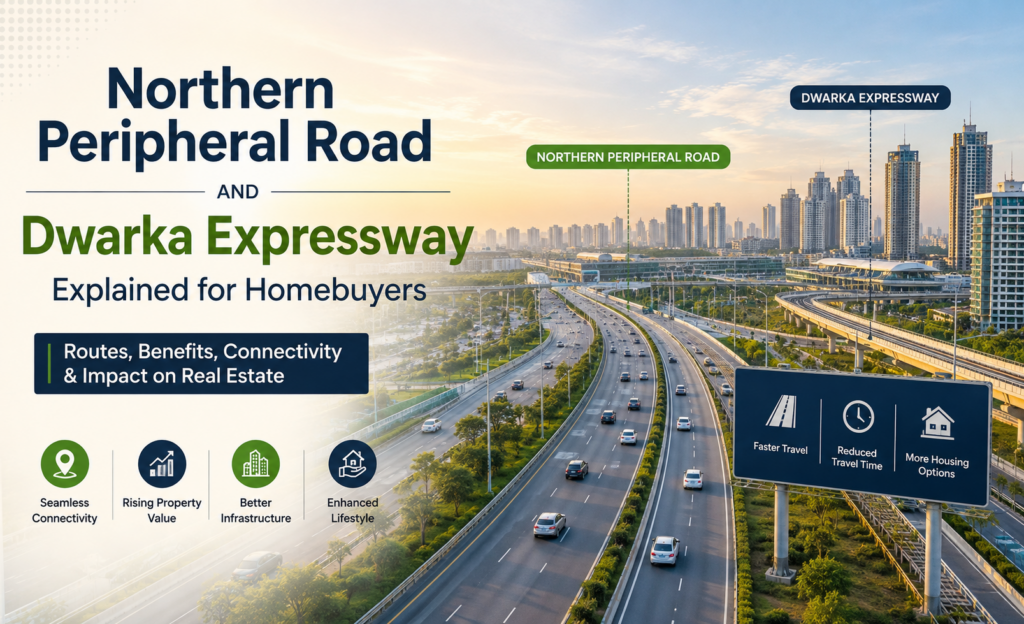
Northern Peripheral Road usually refers, in homebuying conversations around Gurugram, to the Dwarka Expressway corridor linking Dwarka in Delhi with Gurugram in Haryana. That is the main route most buyers mean when they compare sectors, commute times and future neighbourhood convenience. At the same time, the phrase has also appeared in other NCR road reporting, including a proposed road connection discussed for Ghaziabad and East Delhi. So, if you hear “NPR”, it is worth checking which corridor is being referenced.
For a homebuyer, the practical takeaway is simple: these road links matter because they can improve access between emerging sectors and established job, airport and city corridors. Better connectivity may reduce dependence on a single crowded route, but the on-ground benefit still depends on exact entry and exit points, last-mile roads, traffic management and whether your daily destination lies naturally on the corridor.
What is the Northern Peripheral Road?
In the Delhi-Gurugram real-estate context, Northern Peripheral Road is the earlier planning name commonly associated with the Dwarka Expressway. Research cited for this article indicates that the project was planned as the Northern Peripheral Road in 2006 and later transferred to NHAI in 2016. Public information also describes the Dwarka Expressway as a major route connecting Delhi’s Dwarka side with Gurugram.
Some published material uses slightly different figures for the corridor’s length and lane configuration. Because those details vary across sources, buyers should treat them carefully and rely on current official project communications for exact specifications. What is consistently supported is the broader role of the corridor: it is meant to improve connectivity between Delhi and Gurugram and ease pressure on older routes.
There is another reason the term can confuse buyers. Separate NCR reporting has used “Northern Peripheral Road” for a road proposal related to Ghaziabad, NH-9, Delhi-Meerut Road and Tila Mor, with the stated aim of improving access towards East Delhi and other NCR cities. That means the same phrase does not always point to the same geography.
How is Dwarka Expressway connected to Northern Peripheral Road?
The easiest way to understand the relationship is this:
- Northern Peripheral Road is the older or alternate name often used for the Dwarka Expressway in the Delhi-Gurugram belt.
- Dwarka Expressway is the more widely used current name in buyer conversations, listings and infrastructure updates.
- When agents, developers or residents mention sectors “on NPR”, they are usually referring to sectors along or near the Dwarka Expressway corridor.
Research evidence also notes that the Haryana section of Dwarka Expressway was opened in March 2024. That helps explain why buyer interest in the corridor has risen: once a large section becomes operational, the discussion shifts from a future promise to day-to-day usability, though final commuting experience still depends on surrounding road networks.
Why do these roads matter to homebuyers?
Road infrastructure affects property decisions because it shapes everyday life more than brochures do. A project may look attractive on a map, but its liveability often depends on how smoothly you can reach offices, schools, markets, metro links, the airport or family in other NCR cities.
Here is why the corridor matters in practical terms:
1. It can create an alternate Delhi-Gurugram route
For many commuters, the biggest value of the Dwarka Expressway/Northern Peripheral Road is not just speed; it is route choice. An additional major corridor may spread traffic across more than one approach instead of forcing everyone onto older arterial roads.
2. It opens access to newer sectors
Large road projects often make newer sectors easier to approach, especially those that previously felt too interior or inconvenient. For homebuyers, that can mean a wider set of options across budget, unit size and project type.
3. It improves regional movement, not just one micro-market
The broader NCR logic behind peripheral and connector roads is to support movement between city edges, bypass choke points and improve inter-city access. Even where your home is not directly on the road, nearby link roads and junctions may still affect convenience.
4. It may support a more balanced lifestyle decision
Some buyers choose a home mainly for carpet area or price, then struggle with commute stress. Looking at road connectivity early can help balance budget with practical liveability. If you are still weighing markets, browsing current options across fresh bookings can help you compare location versus configuration more realistically.
How these corridors help movement towards Faridabad, Noida and other NCR areas
The user interest behind this topic is often broader than Delhi-Gurugram alone. Buyers want to know how ring roads, peripheral roads and expressways fit together across NCR. The honest answer is: these roads help in different ways, but they do not create one direct universal shortcut for every commute.
What they generally do is improve the larger traffic network by:
- reducing pressure on overloaded inner-city routes,
- offering bypass-style movement around congested patches,
- creating new links between emerging sectors and trunk roads, and
- supporting smoother transitions between Delhi, Gurugram and other NCR corridors.
For example, better connectivity on the Delhi-Gurugram side can be useful for onward journeys to other parts of NCR when supported by connecting roads. But whether your travel to Faridabad or Noida actually becomes easier depends on the specific interchange, the Delhi entry point, the time of day and the strength of the last-mile network on both ends.
That is why buyers should avoid broad assumptions such as “expressway-facing means easy access everywhere”. In reality, a location can be well connected for airport access yet less convenient for daily travel to Noida, or good for west Delhi movement but weaker for south-east Delhi commutes.
What to check before buying near Northern Peripheral Road
If a project is being marketed as “on NPR” or “near Dwarka Expressway”, use a practical checklist rather than relying on the headline alone.
- Pin the exact location on a map. Check whether the project directly abuts the corridor, sits one or two sectors away, or depends on a smaller access road.
- Test the last mile. A 5-minute map estimate can become much longer if the approach road is narrow, unfinished or heavily loaded at peak hours.
- Check your real destination. Measure routes to your office, school, airport terminal, metro station and regular family destinations, not just to a city name.
- Understand entry and exit convenience. Some locations benefit more from the nearest interchange than from the expressway name itself.
- Ask for current, not projected, access details. Marketing material may show future connectors. Distinguish what is operational, what is under execution and what is still proposed.
- Visit at different times. Morning peak, evening peak and weekend conditions can feel very different.
- Review social infrastructure nearby. Good roads help, but liveability also depends on schools, daily retail, healthcare and neighbourhood maturity.
- Check project paperwork independently. Connectivity is only one part of the decision; approvals, construction status and handover-related details still matter.
Northern Peripheral Road vs other NCR road terminology
Buyers often encounter several similar-sounding terms: expressway, peripheral road, ring road, bypass and corridor. These are not always interchangeable.
| Term | Typical meaning | What a homebuyer should ask |
|---|---|---|
| Northern Peripheral Road | Often used for the Dwarka Expressway in the Delhi-Gurugram context; can also refer to other NCR road discussions in media reports | Which exact alignment and city are you referring to? |
| Dwarka Expressway | Major Delhi-Gurugram connectivity corridor | How close is the project to an actual usable access point? |
| Ring road/peripheral road | Roads intended to move traffic around city edges or connect outer sectors | Does it help my route, or is it only useful for through traffic? |
| Link road/connector | Smaller but crucial road joining a project to the main corridor | Is the last-mile link complete and practical today? |
Common misunderstandings to avoid
- “Near expressway” does not always mean walkable or directly accessible.
- One operational section does not guarantee that every surrounding stretch feels seamless.
- Infrastructure headlines do not automatically settle project quality, pricing or fit for your family.
- Peripheral connectivity helps many areas indirectly, but the benefit is never uniform across all sectors.
A simple way to use this information in your home search
If you are exploring homes in Delhi-Gurugram or comparing emerging NCR pockets, use the Northern Peripheral Road/Dwarka Expressway conversation as a starting point, not the final decision rule.
A balanced approach is to shortlist projects based on three layers:
- Connectivity: present-day travel practicality, not just future maps.
- Liveability: schools, retail, daily errands, neighbourhood comfort and noise levels.
- Project fit: layout, size, builder track record, possession stage and your intended holding period.
That way, you treat road infrastructure as one strong decision factor without allowing it to overshadow everything else.
In short, Northern Peripheral Road most commonly means the Dwarka Expressway corridor in the Delhi-Gurugram property market, and its importance lies in improving connectivity across newer sectors and key city routes. It can be highly relevant for homebuyers, but the real value comes from checking exact location, operational access and your own day-to-day commute pattern.
Frequently asked questions
Is Northern Peripheral Road the same as Dwarka Expressway?
In the Delhi-Gurugram property context, Northern Peripheral Road is commonly used as the earlier or alternate name for the Dwarka Expressway corridor. However, the term has also appeared in reporting about other NCR road proposals, so buyers should confirm the exact location being discussed.
Does living near Dwarka Expressway automatically mean an easier commute?
Not automatically. The benefit depends on your project’s exact access road, nearest interchange, final destination and peak-hour traffic conditions. A site visit and route test are more reliable than a map label alone.
Can these roads improve travel to Faridabad and Noida?
They can support broader NCR movement by easing pressure on some existing routes and improving network options. But there is no universal shortcut for every trip, and actual convenience depends on how well your route connects through Delhi and local last-mile roads.
What should I verify before buying a home marketed as being on NPR?
Check the exact plotted location, current road access, nearest entry and exit points, and travel time to your real destinations such as office, school or airport. Also distinguish between operational connectivity and proposed future links shown in sales presentations.
Sources checked
Send us your property requirement
Prefer not to call? Complete the form and the Aditya Estates team will contact you.
Categories
Tags
affordable housing
Central Noida
Commercial leasing
Delhi NCR
Faridabad real estate
Gaurs
Greater Noida
Greater Noida West
Gurugram
Homebuyer guide
Homebuyers
Homebuying
Industrial Real Estate
Infrastructure
Investors
Jewar Airport
Luxury Homes
Market Trends
Metro connectivity
NCR investment
New Launch
Noida
Noida investment
Noida micro-market
Premium housing
Project Analysis
Property comparison
Property Investment
Property Prices
Registration Charges
Rental yield
RERA
Resale flats
Resale property
Residential plots
Retail property
ROI
Sector 18 Noida
Sector 128
Sector 137
Sector 150 Noida
UP RERA
Yamuna Expressway
Yamuna Expressway real estate
YEIDA