
Aditya Estates, based in Noida Sector 18 in the Delhi NCR region > Blog > Infrastructure > Delhi to Agra in 59 Minutes, Lucknow in 2 Hours: Northern Bullet Train Corridor Could Transform India’s Connectivity!
Delhi to Agra in 59 Minutes, Lucknow in 2 Hours: Northern Bullet Train Corridor Could Transform India’s Connectivity!
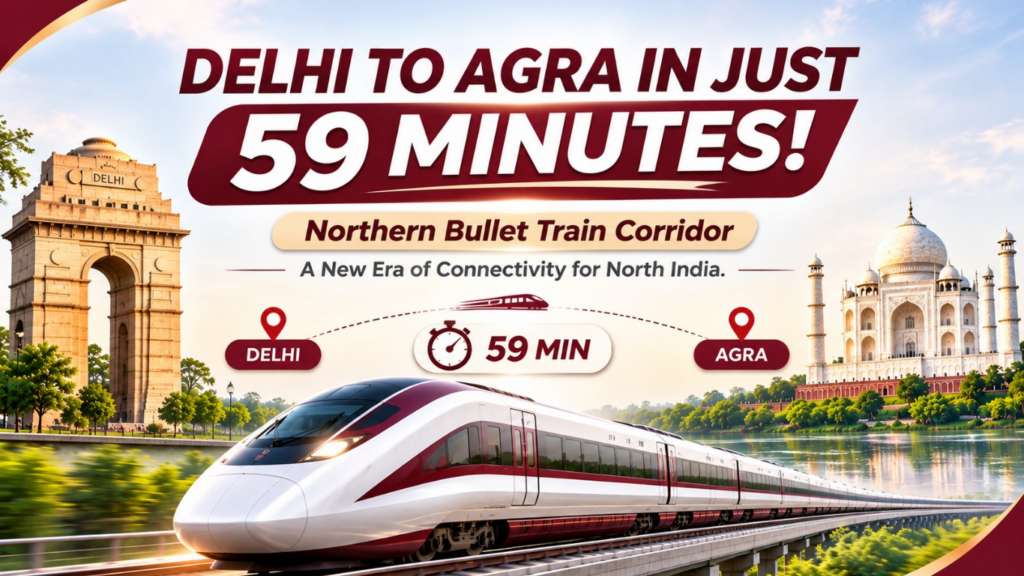
Imagine travelling from Delhi to Agra in just 59 minutes, reaching Kanpur in under two hours and covering the distance between Delhi and Varanasi in approximately three and a half hours.
What once seemed like a distant possibility could become a reality with India’s proposed Northern Bullet Train Corridor.
In a major infrastructure announcement on 31 October 2026, Union Railway Minister Ashwini Vaishnaw confirmed that Prime Minister Narendra Modi had approved the Northern Corridor of India’s bullet train network.
The proposed high-speed rail corridor is expected to connect several important cities across North and East India, including Delhi, Agra, Kanpur, Lucknow, Ayodhya, Varanasi, Prayagraj, Patna and Siliguri, before extending towards Guwahati in Assam.
With significantly reduced travel times, the proposed project could transform intercity connectivity, encourage tourism, support business activities and create new opportunities for regional economic development.
For Delhi-NCR and Uttar Pradesh, this announcement represents another important chapter in India’s expanding infrastructure story.
1. What Is the Northern Bullet Train Corridor?
The Northern Bullet Train Corridor is a proposed high-speed rail connectivity initiative designed to bring major cities across northern and eastern India closer together.
The corridor is expected to connect important urban, commercial, educational and religious destinations through a modern high-speed railway network.
The proposed route includes:
Delhi
Agra
Kanpur
Lucknow
Ayodhya
Varanasi
Prayagraj
Patna
Siliguri
Guwahati
This network could significantly reduce travel time between major cities and make intercity journeys more convenient for tourists, business professionals, students and regular travellers.
The extension towards Guwahati could also improve connectivity between the national capital and the Northeast.
2. Delhi to Agra in 59 Minutes: Expected Travel Times
One of the most exciting aspects of the announcement is the substantial reduction in expected journey times between major cities.
According to the indicative travel-time estimates shared by Railway Minister Ashwini Vaishnaw, the proposed corridor could offer the following journey durations:
| Route | Indicative travel time |
|---|---|
| Delhi to Agra | 59 minutes |
| Delhi to Kanpur | 1 hour 45 minutes |
| Delhi to Lucknow | 2 hours 12 minutes |
| Lucknow to Varanasi | 1 hour 21 minutes |
| Delhi to Varanasi | 3 hours 35 minutes |
These estimates could make several important destinations considerably more accessible from Delhi.
Important: These are indicative journey times announced by the Railway Minister. Final operational timings will depend on the approved alignment, station locations, train operations and project implementation.
3. How Will the Bullet Train Corridor Benefit Uttar Pradesh?
Uttar Pradesh is among the most important states covered by the proposed Northern Bullet Train Corridor.
The network is expected to connect several cities that play significant roles in tourism, business, education and cultural activities.
Agra: A Major Tourism Destination
Agra is home to the iconic Taj Mahal and attracts visitors from across India and around the world.
A proposed 59-minute high-speed journey from Delhi could make Agra more accessible for domestic and international tourists travelling through the capital.
It could also encourage short-duration tourism and improve connectivity between Delhi and the Agra tourism circuit.
Kanpur: Industrial and Commercial Connectivity
Kanpur is an important industrial and commercial centre in Uttar Pradesh.
Improved high-speed connectivity with Delhi could support business travel, professional mobility and commercial interactions between the two cities.
Lucknow: Administrative and Business Connectivity
As the capital of Uttar Pradesh, Lucknow is an important administrative, educational and commercial destination.
An indicative journey time of approximately 2 hours and 12 minutes from Delhi could make intercity travel more convenient for professionals, government officials and business travellers.
Ayodhya: Religious Tourism and Regional Development
Ayodhya has emerged as a major religious tourism destination.
Improved connectivity could support visitor movement and strengthen the city’s position within Uttar Pradesh’s wider tourism ecosystem.
Varanasi: Connecting India’s Cultural Heritage
Varanasi is one of India’s most prominent religious and cultural destinations.
A proposed high-speed connection of approximately 3 hours and 35 minutes from Delhi could make travel more convenient for pilgrims, tourists and business visitors.
4. Why This Project Matters for Delhi-NCR
For Delhi-NCR, the proposed Northern Bullet Train Corridor is significant because it could strengthen connectivity with several major economic and cultural centres.
Faster intercity transportation can potentially support:
Business travel between major commercial cities.
Improved access to educational institutions.
Increased tourism and hospitality activity.
Better movement of professionals and skilled workers.
Greater regional economic interaction.
Improved accessibility to emerging business destinations.
The broader benefits will depend on station accessibility, last-mile connectivity and integration with existing transport infrastructure.
For the National Capital Region, the project also adds to the wider infrastructure transformation taking place across northern India.
5. Will the Bullet Train Corridor Benefit Greater Noida and the Yamuna Expressway Region?
Although the announced route includes Delhi and several major cities in Uttar Pradesh, its direct impact on Greater Noida and the Yamuna Expressway region will depend on the final alignment and confirmed station locations.
However, the proposed high-speed rail network is relevant to the broader NCR infrastructure and investment landscape.
The Greater Noida and Yamuna Expressway region is already witnessing significant infrastructure and industrial development, including:
Noida International Airport, Jewar
The airport is an important aviation infrastructure development expected to strengthen regional and international connectivity.
Yamuna Expressway
The expressway connects Greater Noida with Agra and provides an important road transportation link across the region.
Industrial and Institutional Development
The YEIDA region has several planned and developing industrial, institutional and commercial projects, attracting attention from businesses and investors.
Greater Noida’s Residential and Commercial Growth
With expanding infrastructure and economic activity, Greater Noida continues to attract interest in residential, commercial and industrial real estate.
The proposed Northern Bullet Train Corridor could complement this broader connectivity ecosystem if its final alignment provides suitable integration with the NCR and surrounding development zones.
However, it is important to note that no direct bullet train station in Greater Noida or along the Yamuna Expressway should be assumed without an official confirmation.
6. Potential Impact on Tourism, Business and Real Estate
Large-scale transportation infrastructure can influence regional development by improving accessibility and encouraging economic interaction.
The proposed Northern Bullet Train Corridor could create opportunities across several sectors.
A. Tourism and Hospitality
Faster connectivity between Delhi, Agra, Ayodhya and Varanasi could encourage more convenient multi-city travel.
This could support demand for hotels, hospitality services, restaurants and tourism-related businesses.
B. Commercial and Business Activities
Reduced travel time could make business meetings and professional travel between major cities more convenient.
Companies operating across multiple cities could potentially benefit from improved employee mobility and regional business connectivity.
C. Residential Real Estate
Improved accessibility can influence residential preferences, particularly in locations with convenient access to employment centres and transportation networks.
However, the actual impact on housing demand will depend on station locations, local infrastructure, employment growth and affordability.
D. Industrial and Logistics Development
High-speed passenger rail is primarily designed for passenger transportation. It should not be confused with dedicated freight infrastructure.
Nevertheless, improved passenger connectivity could support industrial regions indirectly by making business travel and workforce movement more efficient.
7. Make in India: A Major Focus of the Bullet Train Project
Another important aspect of the announcement is the emphasis on domestic manufacturing and engineering capabilities.
Railway Minister Ashwini Vaishnaw highlighted the Make in India approach, stating that construction activities, from pillars to girders, would involve indigenous capabilities and Indian workers.
This approach could support opportunities across several sectors, including:
Civil engineering and construction.
Infrastructure development.
Manufacturing of railway components.
Engineering and technical services.
Skilled workforce development.
Construction-related industries.
The project could therefore contribute not only to transportation infrastructure but also to domestic industrial capabilities.
8. What Happens Next? Key Details Still Awaited
Although the Northern Bullet Train Corridor has received approval, several important project details are yet to be publicly finalised.
These include:
Final route alignment and technical planning.
Confirmed station locations across the corridor.
Detailed project cost and financing structure.
Land acquisition and construction requirements.
Construction commencement schedule.
Expected completion and operational timelines.
Final ticket pricing and passenger services.
The announcement is an important policy milestone, but the actual benefits will depend on detailed planning, execution and timely completion.
Conclusion: A New Chapter in India’s Infrastructure Growth
The proposed Northern Bullet Train Corridor could become one of the most significant transportation developments for North and East India.
With indicative travel times of just 59 minutes between Delhi and Agra, approximately 2 hours and 12 minutes between Delhi and Lucknow, and around 3 hours and 35 minutes between Delhi and Varanasi, the project could redefine how people travel between major Indian cities.
Beyond faster journeys, the corridor has the potential to support tourism, business connectivity, employment and regional economic development.
For Delhi-NCR and Uttar Pradesh, this development adds another important dimension to the region’s growing infrastructure ecosystem.
As India moves towards a more connected future, the real opportunity lies in how improved transportation infrastructure can unlock new possibilities for cities, businesses, communities and real estate markets.
Send us your property requirement
Prefer not to call? Complete the form and the Aditya Estates team will contact you.
Categories
Tags
affordable housing
Central Noida
Commercial leasing
Delhi NCR
Delhi NCR property
Family Living
Faridabad real estate
Greater Noida
Greater Noida industrial development
Greater Noida real estate
Greater Noida West
Gurgaon
Gurugram
Homebuyer
Homebuyer guide
Homebuying
Infrastructure
Investor Guide
Jewar Airport
Legal Checks
Luxury Homes
New Launch
Noida
Noida commercial real estate
Noida Expressway
Noida International Airport
Noida investment
Noida Property
Noida property investment
Noida Real Estate
Premium housing
Property comparison
Property Documents
Property Investment
Registration Charges
Rental yield
RERA
Resale flats
Retail property
Sector 150 Noida
Stamp Duty
UP RERA
Yamuna Expressway
Yamuna Expressway real estate
YEIDA
Related articles