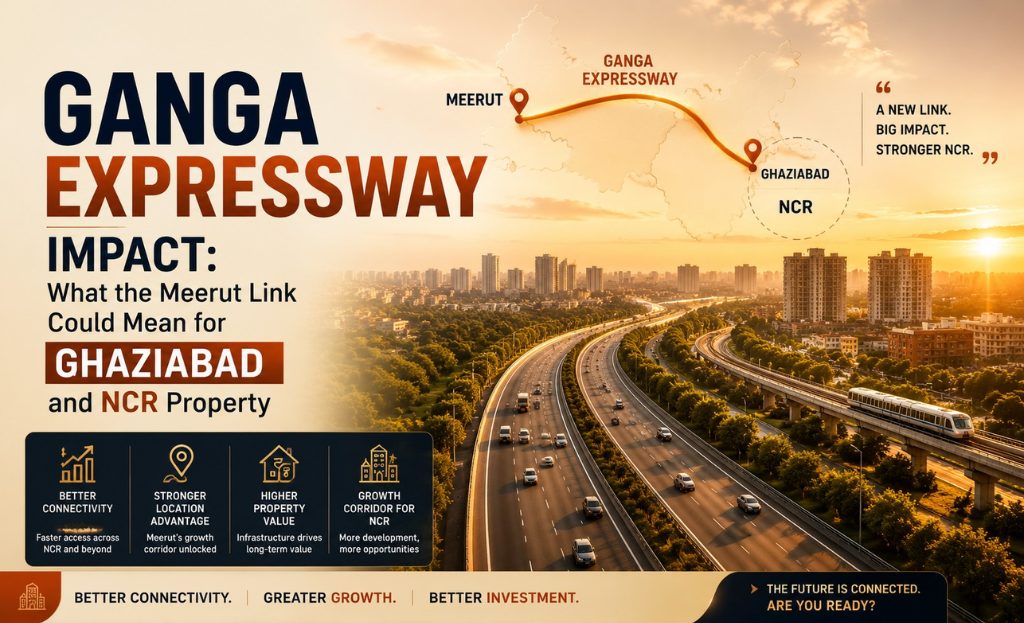
The short answer: the Ganga Expressway impact for Delhi NCR is likely to be strongest through faster access to Meerut and western Uttar Pradesh, with potential spillover into Ghaziabad-led micro-markets that benefit from better road connectivity, warehousing interest and commuter confidence. For investors, that does not automatically mean every plot or project will gain equally, but infrastructure-led demand can change where buyers look next.
The project matters because official material from the Uttar Pradesh Expressways Industrial Development Authority (UPEIDA) describes the Ganga Expressway as a fully access-controlled corridor proposed from the Ghaziabad-Meerut section of NH-58 in Meerut district to Prayagraj. Separate media reports also indicate a planned connection with the Delhi-Meerut Expressway, aimed at improving access from Delhi NCR and reducing long-distance travel times to eastern UP. Some third-party reports suggest Delhi-Prayagraj travel could fall to under seven hours once the broader link is in place, but such time estimates should be treated as indicative until operations stabilise.
For property watchers in NCR, the practical question is not only whether the expressway opens, but which localities gain direct usability. In most infrastructure cycles, the first visible gains usually appear near interchanges, feeder roads, logistics nodes and already-urbanising edges, rather than across an entire city at once.
Why this expressway is drawing so much attention
Infrastructure corridors tend to influence real estate in three overlapping ways: they reduce friction in travel, improve freight movement and reshape buyer perception of distance. Research sources used here broadly agree on those themes, even when their dates and completion claims differ.
Confirmed from UPEIDA: the corridor is intended to support broad-based development across Uttar Pradesh and begins from the Ghaziabad-Meerut side before running eastward to Prayagraj. That western starting point is what makes the project relevant to NCR audiences, especially investors tracking Ghaziabad, Meerut and neighbouring growth belts.
Several external reports further describe the expressway as a high-speed greenfield corridor of roughly 594 km and note a phased rollout or expansion path. However, because completion dates and operational milestones vary across publications, buyers should avoid making decisions based only on a headline deadline.
What appears more reliable than any single date is the underlying direction of change: better linkage between Delhi NCR, Meerut and deeper UP markets. That can support travel convenience, trade routes and land-use changes over time.
How the Meerut connection could change NCR travel patterns
The most immediate relevance for NCR is the proposed connection between the Ganga Expressway and the Delhi-Meerut Expressway. If this linkage functions as expected, travellers from Delhi NCR may be able to access the western start of the corridor more directly, instead of relying on slower fragmented routes.
For end users, that could mean:
- shorter and more predictable road journeys towards Meerut and beyond;
- greater attractiveness of edge locations that feel “far” today but become easier weekend or business drives;
- better freight movement for distributors, e-commerce operators and industrial users;
- higher relevance of highway-facing and feeder-road land parcels in selected belts.
For investors, improved travel times often matter less as a one-day event and more as a behavioural shift. Once households and businesses begin to trust a corridor, search activity can widen from core city zones to peripheral areas. That is where land markets in and around Ghaziabad and the broader Meerut-facing side of NCR may see stronger attention.
Still, there is an important distinction: connectivity does not eliminate local bottlenecks. A fast regional expressway helps most when the last-mile approach roads, service infrastructure, public transport links and surrounding civic systems also improve.
What it could mean for Ghaziabad property markets
Ghaziabad is one of the most obvious NCR beneficiaries to watch, not because every sub-market will react the same way, but because its geography and road networks place it close to the western side of the broader corridor story.
1) Land near movement corridors may gain attention first
In many infrastructure-led cycles, plots and low-density parcels near approach roads, interchanges or warehousing routes attract early speculative interest. That does not confirm a value surge, but it often increases inquiry volumes and owner expectations.
2) Industrial and logistics demand may become more influential
Some reports emphasise the expressway’s economic and logistics role, including faster movement of goods and industrial support. If freight efficiencies improve, then selected Ghaziabad-side industrial, warehousing and mixed-use locations could become more relevant than purely residential speculation zones.
3) Residential demand could shift gradually, not instantly
Owner-occupier demand generally responds more slowly than land speculation. Families usually wait for evidence: easier commutes, stronger social infrastructure, schools, hospitals, retail and visible execution on roads. So the impact may first be seen in sentiment and investor conversations, then later in end-user absorption.
4) Existing projects may benefit differently from new launches
Ready or near-ready inventory in well-connected pockets can sometimes gain from new infrastructure news because buyers can evaluate actual access. By contrast, very early-stage plotted promises farther out need more caution. If you are comparing options, it helps to review both resale opportunities and primary-market supply in the same micro-market rather than assuming a future road alone will justify the price gap.
What about Faridabad?
The brief expectation that Faridabad could see land-value effects needs a more careful reading. Based on the evidence supplied, the direct documented relationship is stronger for Meerut, Ghaziabad and the wider Delhi NCR access story than for Faridabad specifically.
That does not mean Faridabad cannot experience sentiment spillover. Large regional infrastructure can shift investor psychology across NCR, especially if people start pricing in broader economic growth, logistics connectivity or cross-region travel efficiency. But at this stage, any claim of direct price uplift in Faridabad would be more opinion than confirmed fact from the evidence provided.
For Faridabad investors, the useful approach is to separate:
- direct impact: is there a proven route, interchange or feeder advantage?
- indirect sentiment impact: are buyers simply extrapolating from NCR-wide infrastructure optimism?
- local fundamentals: employment catchments, metro/road access, builder track record and actual transaction depth.
In short, Ghaziabad has the clearer evidence-led relevance here; Faridabad is more of a secondary watchlist market unless future official links make the connection more explicit.
Could land values rise? Yes, but not uniformly
One of the most common mistakes in infrastructure investing is assuming that a major road raises all nearby values equally. In practice, outcomes often vary sharply by distance, legal clarity, zoning context, frontage, access quality and timing of entry.
Based on broader corridor behaviour and the research summaries, these are the segments most likely to be watched:
| Segment | Possible effect | Key caution |
|---|---|---|
| Plots near feeder roads | Higher enquiry and speculative pricing interest | Check title, road width and actual access |
| Warehousing and industrial land | Potential demand from transport and logistics users | Verify permitted use and utility readiness |
| Ready residential stock | Improved buyer confidence if travel actually becomes easier | Do not overpay for “future benefit” already priced in |
| Far peripheral land banks | Sentiment-led buzz | Execution and holding periods may be uncertain |
External commentary on expressway-led real estate generally suggests that housing and commercial demand can strengthen along faster corridors as businesses follow infrastructure. That is a reasonable pattern to watch, but it should not be treated as a guarantee for any one colony, village edge or plotted scheme.
Actionable checks before you buy on the Ganga Expressway story
If you are evaluating property based on the Ganga Expressway impact, use a checklist rather than a headline.
- Confirm the exact location advantage. Ask how the asset connects to the expressway or feeder road in real driving terms, not brochure terms.
- Separate official information from promotional claims. Official project descriptions and route alignment matter more than broker exaggeration.
- Check whether the benefit is current or future. If the road linkage is not yet operational, price expectations may be ahead of reality.
- Assess last-mile access. A parcel that is “near the expressway” but difficult to reach may not enjoy the same utility.
- Review transaction evidence. Compare quoted rates with recent local deals, not just asking prices.
- Look beyond residential narratives. In some corridors, logistics and commercial absorption tell the story earlier than housing demand.
- Verify approvals and land records independently. This is especially important in plotted developments and fringe areas.
For a first-level market scan, investors may find it useful to compare under-construction supply with ready inventory and service support, rather than betting on one format alone.
What to watch in the next phase
The next leg of the story is likely to depend on three things: final operational clarity, the quality of the Delhi NCR-to-Meerut linkage and the pace at which supporting economic activity develops around the corridor.
Signals worth monitoring include:
- official updates on completion, commissioning and traffic readiness;
- clarity on the exact connection with the Delhi-Meerut Expressway;
- new warehousing, industrial or logistics announcements in western UP belts;
- changes in land asking prices versus actual registered market activity;
- new residential launches using the corridor as a key sales theme.
If these indicators move together, the expressway could become more than a transport project for NCR investors. It could act as a regional demand reshaper, particularly for Ghaziabad-facing and Meerut-linked markets. If not, the effect may stay concentrated in selected pockets instead of creating a broad-based property wave.
The balanced takeaway is simple: the Ganga Expressway is credible as a connectivity theme, but property outcomes will remain hyper-local. Investors who focus on access, execution and real demand drivers are more likely to read the opportunity correctly than those who buy only on infrastructure excitement.
Frequently asked questions
Why is the Ganga Expressway relevant to Delhi NCR buyers?
It is relevant because official information places the western start of the corridor at the Ghaziabad-Meerut side, and reports indicate a connection with the Delhi-Meerut Expressway. That could make road travel from NCR towards Meerut and eastern UP faster and more predictable over time.
Will the Ganga Expressway definitely increase Ghaziabad property prices?
Not definitely. Better connectivity can improve sentiment and demand, but price movement depends on the exact micro-market, last-mile access, local supply, transaction depth and whether benefits are already priced in.
Is Faridabad a direct beneficiary of this project?
Based on the evidence provided, the direct route relevance appears stronger for Meerut and Ghaziabad than for Faridabad. Faridabad may see indirect sentiment effects, but that is different from a documented direct connectivity advantage.
What type of property could benefit first from the expressway?
Early interest often appears in land near feeder roads, interchange zones, warehousing corridors and ready stock with visible access advantages. End-user residential demand usually follows more gradually once infrastructure usability becomes clear.
What should investors verify before buying near an expressway corridor?
Check exact access, title documents, land use, approvals, utility readiness and realistic drive times. Also compare asking prices with actual local transactions and avoid relying only on future completion claims.
Sources checked
Send us your property requirement
Prefer not to call? Complete the form and the Aditya Estates team will contact you.