Aditya Estates, based in Noida Sector 18 in the Delhi NCR region > Blog > Infrastructure > Greater Noida Is Changing — From Housing Hub to Integrated Economic Ecosystem
Greater Noida Is Changing — From Housing Hub to Integrated Economic Ecosystem
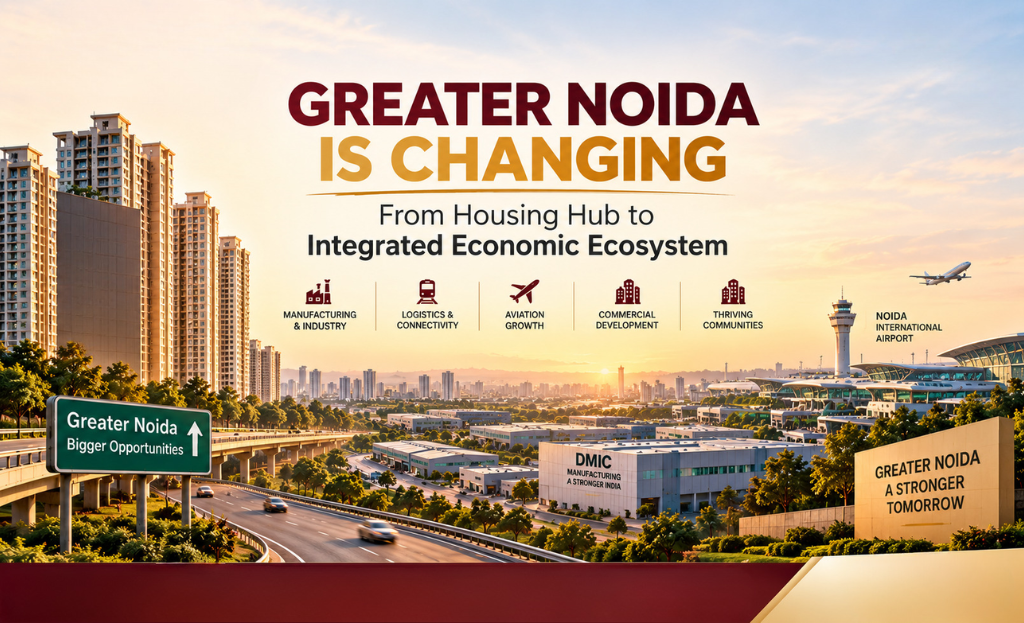
Greater Noida real estate is entering a new phase. What was once largely viewed as a residential extension of Noida is increasingly being shaped by industrial development, logistics, aviation, infrastructure, employment and large-scale residential projects.
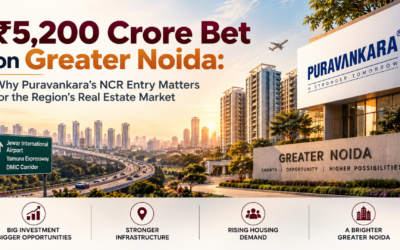
The latest ₹5,200-crore development opportunity announced by Puravankara is another important marker of this transition. But the larger story is not one project—it is the combination of multiple economic drivers developing across the Greater Noida–Yamuna Expressway region.
Greater Noida's Real Estate Story Is Getting Bigger
For years, Greater Noida’s real estate market was primarily discussed in terms of apartments, plotted developments and emerging residential sectors.
That picture is changing.
Today, the region is developing around several interconnected pillars:
Manufacturing + Logistics + Infrastructure + Aviation + Commercial Activity + Residential Real Estate
This combination matters because a sustainable urban ecosystem generally needs more than housing. It needs employment centres, businesses, transportation, services and supporting infrastructure that bring people and economic activity into the same geography.
Greater Noida is increasingly being developed along these lines.
₹5,200 Crore: Why Puravankara's Greater Noida Entry Matters
One of the biggest recent developments came from Bengaluru-based Puravankara, which has entered the Delhi-NCR market with a 13.44-acre land parcel in Greater Noida.
The parcel has approximately 4.57 million sq. ft. of saleable potential and an estimated Gross Development Value (GDV) of around ₹5,200 crore. The land was allotted through a DMIC Authority auction, with reports putting the acquisition cost at approximately ₹340 crore.
Importantly, the ₹5,200 crore figure should be understood as estimated development value/GDV, not ₹5,200 crore of upfront investment.
Puravankara has described its Greater Noida entry as an important step in its expansion into NCR and cited the region’s infrastructure momentum, scale and long-term demand potential.
For Greater Noida, the significance goes beyond the individual project.
It indicates that established developers from outside the NCR are increasingly evaluating the region as a market capable of supporting large-scale development.
The Bigger Story: DMIC's 750-Acre Industrial Ecosystem
Perhaps the most important structural change is taking place beyond residential real estate.
The Integrated Industrial Township–Greater Noida (IIT-GN) is a 750-acre flagship project under the Delhi-Mumbai Industrial Corridor (DMIC).
According to NICDC, the township is located southeast of Greater Noida, close to the Eastern Peripheral Expressway and Delhi–Howrah railway line, around 11 km from Pari Chowk. It also has proximity to the Boraki transit hub and Dadri logistics hub.
The township is designed for sectors including:
- White goods
- Electronics
- Mobile manufacturing
- Biotech
- R&D
- General engineering
NICDC describes the development as having world-class infrastructure for commercial and industrial activity, with companies already operational and additional development underway.
This is significant because it introduces an employment and production layer to Greater Noida’s urban economy.
Instead of a city primarily expanding through housing, the region is developing an ecosystem where businesses, factories, logistics facilities, employees and residential communities can exist within the same broader growth corridor.
From Manufacturing to Residential Demand
This is where the real estate connection becomes particularly interesting.
When industrial and commercial activity expands, it can create demand for supporting services and housing.
Manufacturing units require workers.
Businesses require managers and professionals.
Logistics companies require operational staff.
New economic activity can generate demand for:
Housing → Rentals → Retail → Restaurants → Schools → Healthcare → Offices → Services
This does not mean that every new industrial project automatically increases property prices. Real estate performance depends on factors such as actual employment creation, infrastructure delivery, supply, affordability, project execution and market demand.
However, the development of employment-generating economic infrastructure can create a broader demand base than a residential-only market.
That distinction is important when looking at Greater Noida’s long-term development story.
Jewar Airport Changes the Regional Equation
Another major piece of the puzzle is Noida International Airport at Jewar.
The airport began commercial flight operations on 15 June 2026, with IndiGo becoming the first airline to operate from the airport. The airport initially began with domestic services, while international operations were planned for subsequent phases.
The airport is not simply an aviation project.
Airports can support wider ecosystems involving:
- Logistics
- Cargo
- Hospitality
- Warehousing
- Business travel
- Aviation services
- Retail
- Employment
- Commercial development
The airport has already begun creating employment-oriented initiatives. In September 2026, Noida International Airport and Bird Academy announced a hospitality skill-development programme for local youth, linking workforce development with the emerging aviation and hospitality ecosystem.
For the Greater Noida–Yamuna Expressway region, this adds another economic driver to an already infrastructure-heavy corridor.
Yamuna Expressway: More Than Just a Road
The Yamuna Expressway has historically been an important connectivity link between Greater Noida and the eastern parts of Uttar Pradesh.
Its significance is evolving as development around the corridor expands.
The combination of:
Yamuna Expressway + Noida International Airport + DMIC + Industrial Township + Logistics Infrastructure
creates the foundation for a broader regional economic corridor.
Puravankara’s latest Greater Noida project is also positioned around this infrastructure ecosystem, with the developer citing access to the Yamuna Expressway and the airport’s development as factors supporting the region’s long-term demand potential.
Boraki Could Become Another Important Piece
Greater Noida’s development story also includes the proposed Bodaki/Boraki multimodal transport hub, which is intended to strengthen the region’s rail, road and logistics connectivity.
The Greater Noida authority has also approved a proposed road connection between Junpat and the Eastern Peripheral Expressway, aimed at improving connectivity towards Ghaziabad, Dadri and the proposed multimodal transport hub at Bodaki.
For real estate, multimodal connectivity matters because it can influence how easily people and goods move between employment centres, residential areas and logistics hubs.
Industrial & Logistics Demand Is Already a Broader NCR Trend
Greater Noida’s transformation is also happening within a larger national real estate trend.
Colliers reported that India’s industrial and warehousing demand reached approximately 11 million sq. ft. in Q2 2026 across the top eight cities, up 4% year-on-year. Delhi-NCR accounted for more than 25% of quarterly leasing, with engineering and manufacturing and third-party logistics among the key demand drivers.
CBRE’s H1 2026 snapshot similarly identified Delhi-NCR as one of India’s leading industrial and logistics markets, with 3PL and engineering/manufacturing among the leading sources of leasing demand.
That broader trend gives additional context to Greater Noida’s industrial infrastructure development.
What Does This Mean for Greater Noida Real Estate?
The most interesting question isn’t simply:
“Will Greater Noida property prices rise?”
A more useful question is:
“What kind of city is Greater Noida becoming?”
The answer increasingly appears to be: a mixed economic and urban ecosystem rather than a housing-only market.
The emerging structure looks something like this:
Industrial Development
↓
Manufacturing & Businesses
↓
Employment Creation
↓
Population & Rental Demand
↓
Retail + Commercial Services
↓
Residential Development
↓
Larger Urban Economy
This is the ecosystem investors, homebuyers and developers should watch—not any single project in isolation.
Why This Matters for Property Buyers and Investors
For someone evaluating Greater Noida property investment, looking only at the current apartment price may not provide the complete picture.
A more comprehensive evaluation could include:
1. Connectivity
How easily can the location connect to major roads, expressways, rail and airports?
2. Employment
Are there genuine employment-generating developments nearby?
3. Industrial & Commercial Activity
Are companies actually setting up operations, or is the development still largely planned?
4. Rental Demand
Is there a sustainable tenant base—professionals, employees, students or businesses?
5. Infrastructure Delivery
Are announced projects actually progressing on the ground?
6. Residential Supply
How much competing inventory is available in the micro-market?
7. Development Timeline
Is the investment based on existing infrastructure or expectations about future projects?
These factors can help create a more realistic picture than simply following headlines about future appreciation.
Greater Noida's Next Chapter
Greater Noida’s transformation is still underway.
The ₹5,200 crore estimated GDV opportunity from Puravankara, the 747-acre DMIC Integrated Industrial Township, the operational Noida International Airport, expanding logistics and manufacturing activity, and continuing infrastructure development all point towards a region whose economic base is becoming more diversified.
But this transformation should be viewed as a long-term development process, not as a guarantee of property returns.
The real opportunity lies in understanding where infrastructure, employment, businesses and residential demand intersect.
Greater Noida is no longer just about building homes.
It is increasingly about building an ecosystem around them.
And that could be the most important shift in the region’s real estate story over the coming decade.
Send us your property requirement
Prefer not to call? Complete the form and the Aditya Estates team will contact you.
Categories
Tags
affordable housing
Central Noida
Commercial leasing
Delhi NCR
Faridabad real estate
Gaurs
Greater Noida
Greater Noida West
Gurugram
Homebuyer guide
Homebuyers
Homebuying
Industrial Real Estate
Infrastructure
Investors
Jewar Airport
Luxury Homes
Market Trends
Metro connectivity
NCR investment
New Launch
Noida
Noida investment
Noida micro-market
Premium housing
Project Analysis
Property comparison
Property Investment
Property Prices
Registration Charges
Rental yield
RERA
Resale flats
Resale property
Residential plots
Retail property
ROI
Sector 18 Noida
Sector 128
Sector 137
Sector 150 Noida
UP RERA
Yamuna Expressway
Yamuna Expressway real estate
YEIDA