
Aditya Estates, based in Noida Sector 18 in the Delhi NCR region > Blog > Infrastructure > From 4,000 to 11,000 Hectares: Why YEIDA Is Rethinking New Hathras
From 4,000 to 11,000 Hectares: Why YEIDA Is Rethinking New Hathras
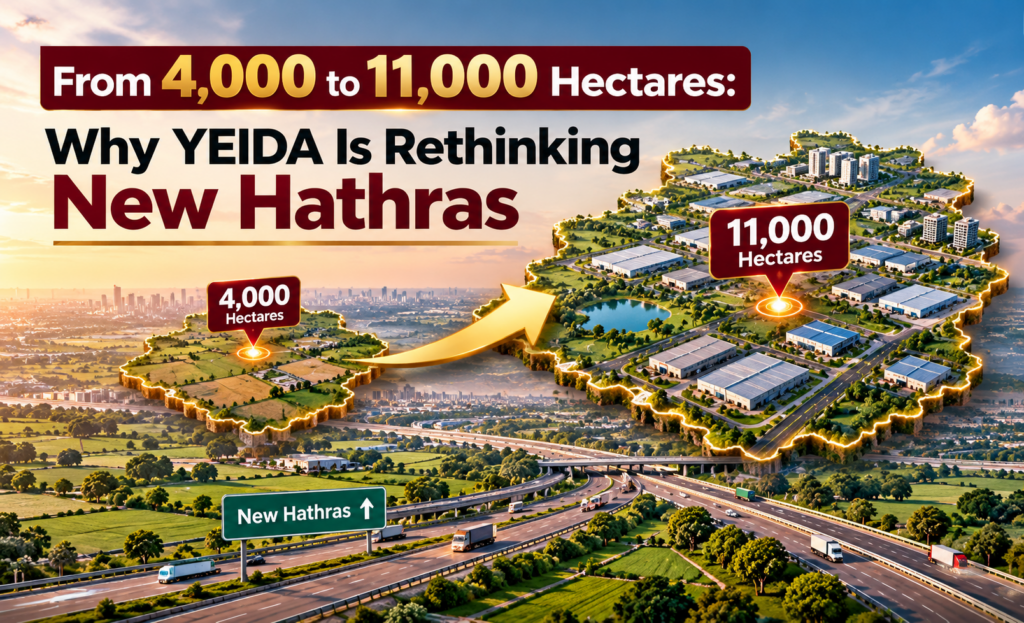
YEIDA is reconsidering the scale of its proposed New Hathras industrial city, with the planned development area now being expanded from 4,000 hectares to around 11,000 hectares. The move could significantly reshape the region’s long-term industrial, urban and connectivity landscape.
A Much Bigger New Hathras Is Now Being Planned
The Yamuna Expressway Industrial Development Authority (YEIDA) is preparing to expand the proposed New Hathras Urban/Industrial Centre from its earlier 4,000-hectare plan to approximately 11,000 hectares.
According to the latest report published on 2 October 2026, YEIDA was not satisfied with the earlier 4,000-hectare footprint and has instructed RV Engineering Consultants, the agency preparing the master plan, to undertake a fresh survey and redesign the plan around the larger area.
The decision is significant because the project is being conceived not simply as an industrial estate, but as a broader urban and industrial growth centre under YEIDA’s Phase-II planning.
Why Has YEIDA Increased the Area?
One of the major concerns identified by YEIDA is whether 4,000 hectares would be sufficient to accommodate the infrastructure, industries and urban facilities envisioned for New Hathras.
According to YEIDA officials cited in the latest report, connectivity is also a challenge because some of the proposed locations are significantly distant from the existing expressway network.
Expanding the planning area could provide greater flexibility for:
- Industrial development
- Residential areas
- Commercial zones
- Logistics and warehousing
- Institutional infrastructure
- Green and open spaces
- Roads and other urban infrastructure
The authority is also examining locations close to an existing railway line, which could potentially provide an additional transportation link for the future industrial centre.
New Hathras Is Part of YEIDA's Larger Phase-II Vision
New Hathras isn’t being planned in isolation.
YEIDA’s Phase-II planning covers districts including Hathras, Aligarh, Mathura and Agra, with several urban centres being planned or studied in the region. Earlier plans identified New Hathras as one of the proposed urban nodes alongside developments such as Tappal-Bajna, Raya and New Agra.
The broader objective is to create planned industrial and urban centres that can support economic activity beyond the existing Noida-Greater Noida core.
Hathras Already Has a Strong Industrial Base
An important factor behind the New Hathras proposal is the region’s existing industrial ecosystem.
Earlier reports have highlighted more than 10,000 registered MSME units and cottage industries in Hathras. The planned development could provide these businesses with better infrastructure while creating space for new industrial clusters and manufacturing activity.
Potential sectors discussed for the broader New Hathras development include:
- Food processing
- Dairy
- Hosiery
- Glass beads
- Brass jewellery
- Machine tools
- EV components
- Other manufacturing and logistics activities
The objective is to combine the existing industrial strengths of Hathras with modern planned infrastructure.
Connectivity Could Be a Key Factor
For any large industrial city, connectivity is as important as land availability.
The New Hathras proposal is being evaluated in relation to road and railway connectivity, while its broader position within the YEIDA planning region gives it a connection to the larger Yamuna Expressway–Jewar Airport growth story.
A June 2026 report had described the proposed Hathras Urban Centre as a mixed-use industrial and residential satellite town linked to the wider catchment of Noida International Airport at Jewar.
However, it is important to distinguish between planned connectivity and currently operational connectivity. Much of the project’s infrastructure will depend on future planning, approvals and execution.
What Does the 11,000-Hectare Proposal Mean for Real Estate?
The expansion does not automatically mean that property prices will rise or that development will happen immediately.
But from a long-term urban-planning perspective, a larger planned industrial centre can potentially create demand across several real-estate categories.
1. Industrial & Logistics
A larger industrial footprint could require:
- Manufacturing facilities
- Warehouses
- Distribution centres
- Ancillary industries
- Industrial plots
2. Residential Development
As employment centres grow, demand for housing can emerge around them. Planned residential sectors could eventually support employees and businesses associated with the industrial hub.
3. Commercial Real Estate
Industrialisation can also generate demand for:
- Retail
- Offices
- Hotels
- Restaurants
- Business services
- Healthcare and education
4. Infrastructure-Led Development
Roads, railway connectivity and other infrastructure can influence how quickly surrounding areas develop.
The 4,000 → 11,000 Hectare Shift Is the Real Story
The most important point isn’t simply that New Hathras will cover 11,000 hectares.
The bigger story is that YEIDA is reconsidering the original scale of the project before finalising its master plan.
Earlier in 2026, the project was being planned around approximately 4,000 hectares and a 20-year development vision. The latest decision indicates that YEIDA believes a larger planning footprint may be necessary to accommodate the city’s infrastructure and industrial ambitions.
The master plan will now need to be revised based on a fresh survey.
What Happens Next?
The immediate next step is fresh surveying and master-plan preparation for the expanded area.
YEIDA also plans to consult the local administration and relevant departments regarding existing infrastructure, industrial potential and development requirements. A meeting under the chairmanship of the Aligarh divisional commissioner is expected to gather inputs from district officials and other departments.
This means the 11,000-hectare figure should currently be viewed as a planning proposal, rather than completed land development.
Why This Matters for the Yamuna Expressway Region
The Yamuna Expressway region is gradually evolving from a single-corridor story into a larger network of planned industrial and urban centres.
With YEIDA planning developments across multiple districts and the continuing development around Jewar Airport, the next phase of growth could increasingly involve areas beyond the established Noida-Greater Noida markets.
New Hathras is therefore worth watching—not because the transformation is already complete, but because the scale of the proposed transformation is getting considerably larger.
Bottom Line
4,000 hectares was the original vision. 11,000 hectares could become the revised planning footprint.
If the expanded master plan progresses through the required surveys, approvals, land processes and infrastructure execution, New Hathras could emerge as an important industrial and urban node in western Uttar Pradesh.
For real-estate observers, the key things to watch next are the final master-plan boundaries, land-use distribution, connectivity plans, land acquisition/land assembly progress and infrastructure execution.
Sources Checked
Send us your property requirement
Prefer not to call? Complete the form and the Aditya Estates team will contact you.
Categories
Tags
affordable housing
Central Noida
Commercial leasing
Delhi NCR
Delhi NCR property
Faridabad real estate
Greater Noida
Greater Noida real estate
Greater Noida West
Gurgaon
Gurugram
Homebuyer
Homebuyer guide
Homebuying
Infrastructure
Investor Guide
Jewar Airport
Legal Checks
Luxury Homes
New Launch
Noida
Noida International Airport
Noida investment
Noida micro-market
Noida Property
Noida Real Estate
Premium housing
Property comparison
Property Investment
Registration Charges
Rental yield
RERA
Resale flats
Resale property
Retail property
ROI
Sector 18 Noida
Sector 128
Sector 137
Sector 150 Noida
Stamp Duty
UP RERA
Yamuna Expressway
Yamuna Expressway real estate
YEIDA