
Aditya Estates, based in Noida Sector 18 in the Delhi NCR region > Blog > News and Quarterly Updates > Barapullah Phase III Opens: What This New Delhi–Noida Connectivity Link Could Mean for Real Estate
Barapullah Phase III Opens: What This New Delhi–Noida Connectivity Link Could Mean for Real Estate
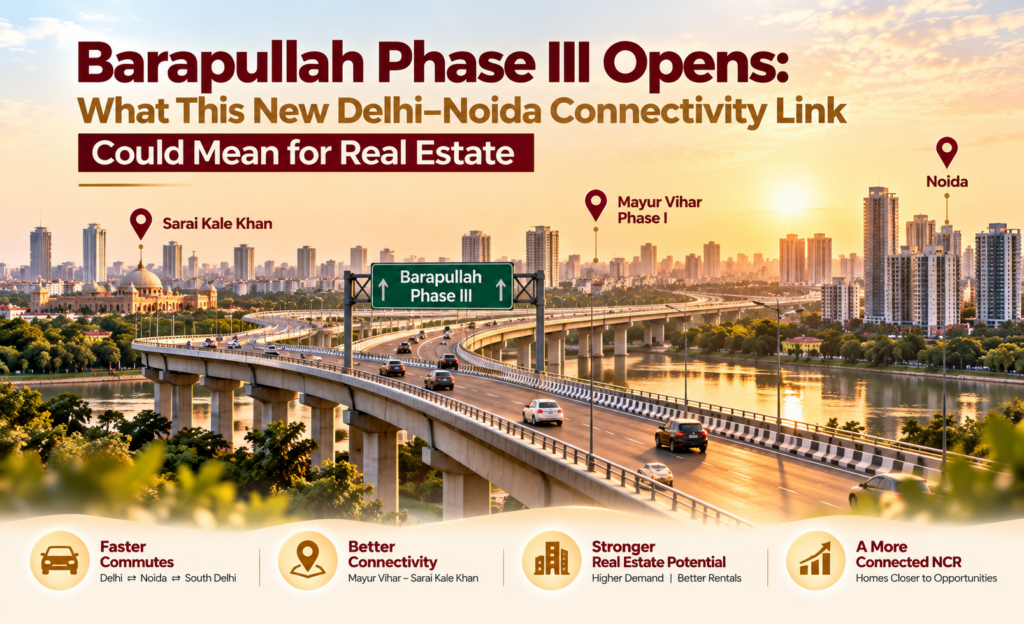
A major piece of Delhi-NCR infrastructure has finally become operational. Barapullah Phase III was inaugurated on September 29, creating a signal-free connection between Mayur Vihar Phase I and Sarai Kale Khan and extending the existing Barapullah corridor towards AIIMS. The new 3.5-km, three-lane elevated corridor is designed to improve movement between East Delhi, Noida and South Delhi.
For the real-estate market, however, the bigger story is not simply the opening of another flyover. It is about how improved connectivity can change the relationship between residential locations and employment hubs.
From Noida to South Delhi: A New Connectivity Option
According to government estimates reportes , the corridor could reduce the average travel time between East Delhi/Noida and AIIMS from around 35–40 minutes to approximately 15 minutes, depending on the starting point and traffic conditions.
The corridor merges with the existing Barapullah network at Sarai Kale Khan, creating an approximately 9-km continuous elevated route towards the AIIMS side.
It is also expected to provide an alternative route for traffic that currently converges around the DND, Ring Road and Sarai Kale Khan.
For Noida commuters heading towards South Delhi, this creates another connectivity option rather than relying entirely on existing routes.
Why This Matters for Noida Real Estate
Connectivity has always been an important factor in residential real estate.
A home may offer attractive specifications, amenities and pricing, but its practical value to an end-user is also influenced by a simple question:
“How easily can I reach my workplace, schools, hospitals and major city destinations?”
The Barapullah Phase III corridor potentially strengthens this equation for parts of Noida that have relatively convenient access towards Mayur Vihar and the eastern Delhi side.
A Hindustan Times real-estate analysis identified Delhi-facing Noida sectors including Sectors 15A, 16A, 44 and 94, along with Mayur Vihar, Vasundhara Enclave and Patparganj, as areas that could potentially experience connectivity benefits. It also noted that the impact would not necessarily be uniform across Noida.
That distinction is important: better connectivity does not automatically translate into an immediate increase in property prices. The actual effect depends on proximity to access points, travel-time savings, existing demand, housing supply and how much of the infrastructure benefit may already be reflected in prices.
The Location Premium Could Become More Important
The opening reinforces a broader trend in NCR real estate: location is increasingly being evaluated through connectivity networks rather than simply municipal boundaries.
For a buyer considering a Noida property, the relevant question is increasingly not just:
Which sector is the property in?
but also:
How quickly can I connect to Delhi, major employment hubs, expressways, metro stations and other parts of NCR?
This is particularly relevant for Delhi-facing Noida, where road connectivity to East and South Delhi can directly influence daily commuting patterns.
More Than Just a Flyover
Barapullah Phase III is part of a larger transportation ecosystem around Sarai Kale Khan.
The corridor improves access to a major multimodal hub that includes Indian Railways, ISBT, Delhi Metro, NCRTC and the Delhi–Mumbai Expressway, according to reports.
The project also includes a dedicated cycle track and pedestrian infrastructure, while its Yamuna crossing incorporates a special bridge structure designed around the floodplain.
This makes the development relevant beyond automobile connectivity.
Could Property Demand Increase?
The answer requires some caution.
Infrastructure improvements can make a locality more accessible and potentially expand its practical catchment area. That can support residential demand, rental demand and commercial activity over time.
However, there is no basis to assume that every property in Noida will see the same impact simply because Barapullah Phase III has opened.
Hindustan Times reported that some real-estate professionals expect stronger benefits for locations closest to the corridor and its access points, while also noting that some anticipated benefits may already have been incorporated into property prices because the project had been under development for more than a decade.
That makes the next phase particularly interesting: how the market responds after the infrastructure becomes operational rather than merely being announced or under construction.
The Bigger NCR Real-Estate Picture
Barapullah Phase III is another example of how infrastructure and real estate are increasingly interconnected across the Delhi-NCR region.
Noida’s real-estate story is already being shaped by multiple connectivity projects, including:
- Delhi–Noida connectivity corridors
- Noida-Greater Noida Expressway
- Metro expansion
- Eastern Peripheral Expressway
- Delhi–Mumbai Expressway connectivity
- Noida International Airport
- Regional rapid-transit infrastructure
Together, these projects are gradually creating a more interconnected NCR rather than isolated property markets.
For homebuyers and investors, that means commute time, access to employment centres and future infrastructure should be considered alongside price, configuration, developer, amenities and rental potential.
What Should Homebuyers Watch Now?
The opening of Barapullah Phase III provides an opportunity to reassess properties based on actual connectivity rather than just advertised connectivity.
Before buying, prospective buyers should examine:
1. Actual travel route — not just straight-line distance.
2. Access to the corridor — how easily can the property reach its entry points?
3. Peak-hour travel time — connectivity benefits should be evaluated during real commuting hours.
4. Metro and road connectivity together — multimodal access can be particularly relevant.
5. Employment hubs — consider where the household actually works.
6. Existing property pricing — determine whether the expected infrastructure benefit is already reflected in the asking price.
The Bigger Takeaway
Barapullah Phase III is more than a new elevated road. It represents another step towards a more connected Delhi-NCR.
For Noida’s real-estate market, the immediate story is better access to Delhi and South Delhi, while the longer-term question is how this improved connectivity influences where people choose to live, rent and work.
As NCR’s infrastructure network expands, connectivity is likely to remain one of the most important variables in understanding the region’s evolving real-estate landscape.
Sources Checked
Send us your property requirement
Prefer not to call? Complete the form and the Aditya Estates team will contact you.
Categories
Tags
affordable housing
Central Noida
Commercial leasing
Delhi NCR
Faridabad real estate
Gaurs
Greater Noida
Greater Noida West
Gurugram
Homebuyer guide
Homebuyers
Homebuying
Industrial Real Estate
Infrastructure
Investors
Jewar Airport
Luxury Homes
Market Trends
Metro connectivity
NCR investment
New Launch
Noida
Noida investment
Noida micro-market
Premium housing
Project Analysis
Property comparison
Property Investment
Property Prices
Registration Charges
Rental yield
RERA
Resale flats
Resale property
Residential plots
Retail property
ROI
Sector 18 Noida
Sector 128
Sector 137
Sector 150 Noida
UP RERA
Yamuna Expressway
Yamuna Expressway real estate
YEIDA