
Aditya Estates, based in Noida Sector 18 in the Delhi NCR region > Blog > News and Quarterly Updates > From Logistics to Industry: How YEIDA Is Building a New Economic Corridor Around Noida Airport
From Logistics to Industry: How YEIDA Is Building a New Economic Corridor Around Noida Airport
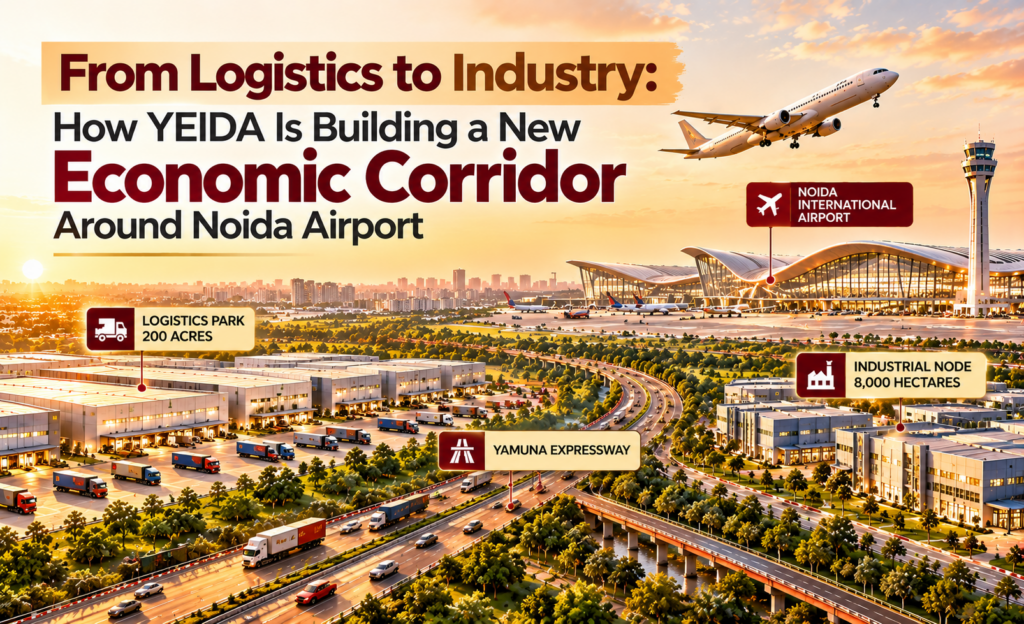
The Yamuna Expressway region is entering a new phase of development. What was once largely discussed in terms of residential projects, expressway connectivity and the upcoming Noida International Airport is increasingly taking shape as a broader industrial, logistics and trade ecosystem.
The latest decisions by the Yamuna Expressway Industrial Development Authority (YEIDA) reinforce this shift. At its 93rd board meeting, YEIDA approved a 200-acre multimodal logistics park at Tappal-Bajna and advanced plans for an approximately 8,000-hectare industrial node south of Noida International Airport.
Together, these initiatives could add another important layer to the emerging Noida Airport–Yamuna Expressway economic corridor.
A 200-Acre Logistics Park at Tappal-Bajna
One of the key decisions is the development of a 200-acre multimodal logistics park at Tappal-Bajna within the YEIDA region.
According to YEIDA, land for the project will be offered to eligible investors through e-auction. The objective is to strengthen modern supply-chain infrastructure, attract investment and support employment in the Yamuna region.
The broader logistics-park concept is designed around multiple modes of transportation. YEIDA’s project information describes the proposed facility as providing road and rail connectivity, customs-related facilities, single-window services and value-added logistics services, with the potential to develop into a significant warehousing and storage hub.
Why is this important?
A logistics park is more than a collection of warehouses.
A successful multimodal logistics ecosystem can bring together:
- Warehousing
- Freight movement
- Distribution centres
- Supply-chain companies
- Manufacturing support
- Packaging and processing
- Transportation services
- Customs and trade-related services
- Ancillary commercial activity
That makes logistics infrastructure an important component of an industrial corridor.
The Bigger Story: An 8,000-Hectare Industrial Node
The more ambitious proposal is the planned industrial node of approximately 8,000 hectares south of Noida International Airport.
YEIDA is currently progressing the planning process, including the appointment of a consultant to prepare the master plan/technical feasibility framework.
The proposed industrial area is intended to support a wider range of activities, including factories, warehouses and light manufacturing, alongside supporting infrastructure.
This is significant because it moves the development narrative beyond an airport-led real-estate story.
The emerging model is increasingly:
Airport + Expressway + Logistics + Manufacturing + Warehousing + Trade + Commercial Activity
That combination can create a much broader economic ecosystem.
Why the Airport Is Only One Part of the Story
For several years, the Noida International Airport has been one of the major infrastructure narratives around the Yamuna Expressway.
But an airport by itself does not create an economic corridor.
The surrounding ecosystem matters.
Air connectivity becomes considerably more economically useful when it is supported by:
Industrial land → Manufacturing → Warehousing → Logistics → Distribution → Trade → Employment
This is where the latest YEIDA plans become particularly relevant.
The proposed logistics park can support movement and storage, while the larger industrial node can provide space for businesses and manufacturing activities.
In simple terms:
The airport can provide connectivity. The industrial ecosystem can create economic activity around that connectivity.
From Airport Corridor to Industrial Corridor
The direction of development suggests that the Yamuna Expressway region is gradually being planned as more than a residential extension of Noida and Greater Noida.
The objective is to build an integrated economic geography.
The proposed 8,000-hectare industrial node is expected to support industrial investment, employment and logistics infrastructure around the airport.
This also fits into YEIDA’s wider sector-based development strategy.
The authority is already developing specialised industrial areas, including the Medical Device Park, Apparel Park, MSME Park and Handicraft Park, while reviewing progress on industrial plot allotments.
As of the latest board-meeting review:
- 295 industrial plots larger than 4,000 sq m were under review
- Lease deeds had been executed for 181
- Possession had been given for 152
- Construction had started on 69
- Production had commenced in 13 units
These numbers show that industrial development in the YEIDA region is not limited to future proposals; parts of the existing industrial ecosystem are already moving through implementation.
What Could This Mean for Logistics and Warehousing?
Industrial growth and logistics growth generally reinforce each other.
A manufacturing unit needs:
- Raw materials
- Storage
- Transportation
- Distribution
- Packaging
- Supply-chain services
Likewise, logistics operators benefit from proximity to manufacturing clusters and major transport infrastructure.
That creates the possibility of a cluster effect.
As more industrial activity develops, demand for supporting logistics infrastructure can potentially expand. In turn, better logistics infrastructure can make an industrial location more attractive to businesses.
The proposed Tappal-Bajna logistics park is therefore important not only as a standalone project but as part of the larger industrial strategy.
The Real Estate Connection
For real estate, the most interesting part of this story is not simply the announcement of a large industrial node.
It is the potential change in land-use dynamics around the corridor.
Industrial development can create demand for different categories of real estate, including:
Industrial real estate
Factory plots, manufacturing facilities and industrial campuses.
Logistics real estate
Warehouses, distribution centres and supply-chain facilities.
Commercial real estate
Offices, retail, business services and supporting commercial establishments.
Hospitality
Hotels and business accommodation can benefit from increasing business travel and industrial activity.
Residential development
A growing employment base can create demand for housing for workers, managers and professionals.
However, these are potential effects rather than guaranteed outcomes. The timing and scale of real-estate demand will depend on actual industrial investment, infrastructure delivery, employment creation and occupancy.
Why Tappal-Bajna Matters
Tappal-Bajna is strategically relevant because it sits within the broader economic geography connecting the Yamuna Expressway, Noida International Airport and the wider industrial region.
YEIDA’s own logistics-park description highlights the potential for road and rail connectivity and the development of storage and warehousing facilities.
This creates the possibility of an interconnected network rather than isolated developments:
Noida International Airport
↓
Yamuna Expressway
↓
Industrial Clusters
↓
Multimodal Logistics
↓
Warehousing & Distribution
↓
Manufacturing & Trade
That is the foundation of an economic corridor.
YEIDA's Industrial Push Comes at an Important Time
The latest decisions also come as Uttar Pradesh continues to position itself around manufacturing, technology, logistics and infrastructure-led investment.
The state has been developing sector-specific policies covering areas such as semiconductors, electronics, defence, data centres and green energy, while expanding its expressway and industrial infrastructure.
For the Yamuna region, this creates an opportunity to connect state-level industrial ambitions with airport and expressway infrastructure.
The proposed industrial node could therefore become one piece of a much larger industrial-development strategy.
Another Important Development: Infrastructure Maintenance
YEIDA’s 93rd board meeting also approved a Corpus Fund Investment Regulation for 2026–27.
Under the mechanism, eligible non-recurring receipts, including one-time lease-related revenue, can be placed into a corpus and invested according to prescribed rules. The interest and permitted receipts can then support maintenance of civic infrastructure such as:
- Roads
- Water supply
- Sewage
- Drainage
- Street lighting
- Parks
- Green belts
This may appear separate from the industrial story, but infrastructure maintenance becomes increasingly important as an industrial and urban corridor expands.
Industrial growth requires not only new infrastructure but also reliable maintenance of the infrastructure already built.
What Investors and Businesses Should Watch
The announcements are significant, but the next stage will be more important than the announcement itself.
Businesses and real-estate stakeholders should watch:
1. Master planning of the 8,000-hectare industrial node
The detailed master plan will determine land-use distribution, infrastructure requirements and the types of industries that can be accommodated.
2. Investor participation
The response to e-auction opportunities will provide a useful indication of market interest in the logistics ecosystem.
3. Connectivity infrastructure
Road, rail and airport connectivity will determine how efficiently the industrial ecosystem can function.
4. Actual industrial occupancy
Announcements matter, but actual land allotment, construction, production and employment will ultimately determine the corridor’s economic impact.
5. Supporting real estate
The emergence of industrial and logistics clusters could create opportunities for commercial, hospitality and residential development, but these should be evaluated based on specific locations and project fundamentals rather than simply the broader corridor narrative.
What This Could Mean for Yamuna Expressway Real Estate
The Yamuna Expressway real-estate story is gradually becoming more diversified.
Earlier, much of the conversation centred around:
Residential projects + Expressway connectivity + Future Airport
The emerging narrative is broader:
Airport + Industrial Development + Logistics + Manufacturing + Warehousing + Trade + Employment + Residential Demand
That distinction matters.
A mature economic corridor typically needs more than housing. It needs jobs, businesses, transportation, logistics, commercial spaces and supporting services.
YEIDA’s latest industrial and logistics plans point towards that broader ecosystem.
The Bigger Picture
The most important takeaway from YEIDA’s latest announcement is not simply the number 200 acres or 8,000 hectares.
It is the change in development direction.
A logistics park can support the movement of goods.
An industrial node can provide space for manufacturing.
An airport can provide national and international connectivity.
An expressway can connect the region to major markets.
And together, these components can form the foundations of a larger economic corridor.
The real test, however, will be execution—how quickly land is developed, infrastructure is delivered, businesses establish operations and planned industrial projects translate into actual economic activity.
For the Noida–Greater Noida–Yamuna Expressway region, this is therefore a development story worth watching closely.
Conclusion
From Logistics to Industry, YEIDA’s latest plans indicate a broader ambition for the region around Noida International Airport.
The proposed 200-acre multimodal logistics park at Tappal-Bajna and the planned approximately 8,000-hectare industrial node south of the airport could provide two important building blocks for an integrated industrial and supply-chain ecosystem.
For businesses, the story is about connectivity and supply chains.
For manufacturers, it is about industrial land and infrastructure.
For logistics companies, it is about warehousing and freight movement.
And for the real-estate sector, it is about the potential emergence of a much broader employment and commercial ecosystem around the Yamuna Expressway.
The next chapter of the Yamuna Expressway may not be defined by the airport alone—it could increasingly be defined by what develops around it.
Send us your property requirement
Prefer not to call? Complete the form and the Aditya Estates team will contact you.
200 acre logistics park 8000 hectare industrial node Greater Noida real estate industrial corridor Uttar Pradesh. Jewar Airport logistics hub near Noida Airport Noida Airport development Noida International Airport Tappal Bajna logistics park Yamuna Expressway industrial corridor Yamuna Expressway real estate YEIDA industrial development YEIDA industrial node 2026 YEIDA logistics park
Categories
Tags
affordable housing
Central Noida
Commercial leasing
Delhi NCR
Faridabad real estate
Gaurs
Greater Noida
Greater Noida West
Gurugram
Homebuyer guide
Homebuyers
Homebuying
Industrial Real Estate
Infrastructure
Investors
Jewar Airport
Luxury Homes
Market Trends
Metro connectivity
NCR investment
New Launch
Noida
Noida investment
Noida micro-market
Premium housing
Project Analysis
Property comparison
Property Investment
Property Prices
Registration Charges
Rental yield
RERA
Resale flats
Resale property
Residential plots
Retail property
ROI
Sector 18 Noida
Sector 128
Sector 137
Sector 150 Noida
UP RERA
Yamuna Expressway
Yamuna Expressway real estate
YEIDA