Aditya Estates, based in Noida Sector 18 in the Delhi NCR region > Blog > News and Quarterly Updates > NCR Home Prices Jump 12% in Q3 2026: Luxury Housing Drives Growth
NCR Home Prices Jump 12% in Q3 2026: Luxury Housing Drives Growth
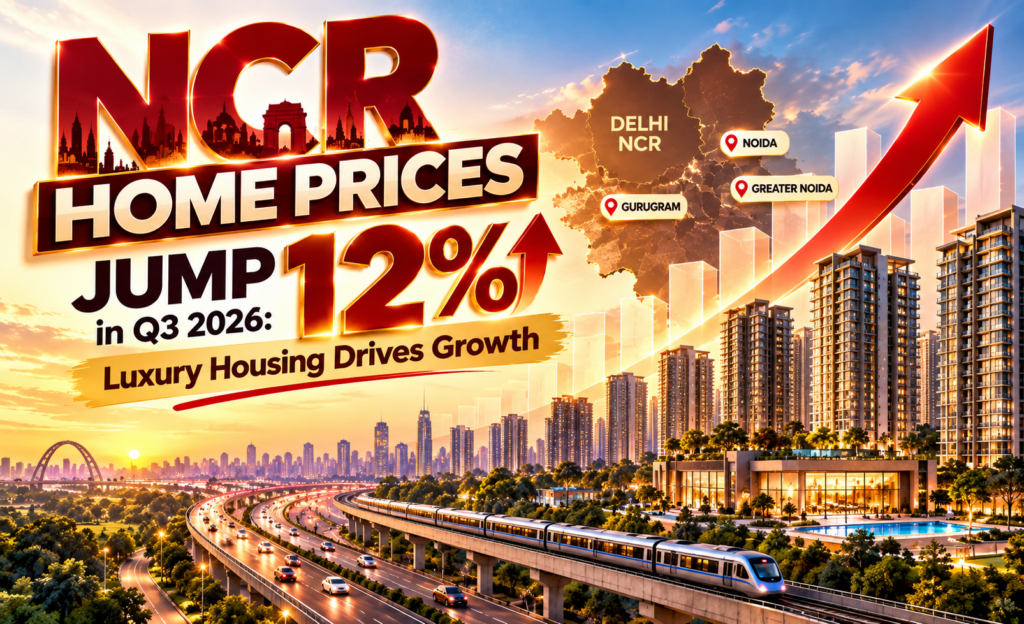
Delhi-NCR’s residential real estate market has recorded a significant price increase in the third quarter of 2026, with home prices rising approximately 12% year-on-year (YoY) during July–September.
According to ANAROCK data reported by The Tribune, NCR recorded the fastest residential price growth among India’s seven major property markets during Q3 2026. The increase comes at a time when the region is also witnessing strong interest in premium and luxury housing, even though overall sales and new launches have moderated slightly.
The latest numbers highlight an important shift in the Delhi-NCR property market: buyers are increasingly looking beyond simply owning a home and are showing greater interest in location, connectivity, amenities, quality and lifestyle.
More than 34% of NCR’s new residential supply in Q3 was priced above ₹2.5 crore, providing a clear indication of the growing importance of the luxury housing segment.
So, what exactly is driving NCR’s property prices higher?
1. NCR Leads India's Major Property Markets in Price Growth
The 12% increase places NCR at the top among India’s seven major residential markets in terms of annual price appreciation.
For comparison, average residential prices across the seven cities increased approximately 7% YoY, while Bengaluru recorded around 8% growth.
This makes NCR’s 12% increase particularly notable.
However, the figure represents a market-level average. It does not mean every property in Noida, Greater Noida, Gurugram, Ghaziabad or other NCR locations appreciated by exactly 12%.
Property prices can vary substantially depending on the specific:
- Location
- Sector
- Project
- Developer
- Property size
- Configuration
- Construction stage
- Connectivity
- Buyer demand
For this reason, NCR’s overall price-growth figure should be viewed as a broad market indicator rather than a guarantee of individual property appreciation.
2. Luxury Housing Is Reshaping NCR's Residential Market
One of the strongest signals from the Q3 data is the increasing importance of premium and luxury housing.
More than 34% of NCR’s new housing supply during Q3 2026 was priced above ₹2.5 crore.
This is significant because developers are increasingly bringing projects to market that target buyers seeking more than basic residential accommodation.
Today’s luxury homebuyer may place greater emphasis on:
- Larger apartment layouts
- Premium specifications
- High-end clubhouses
- Wellness and fitness facilities
- Landscaped open spaces
- Smart-home features
- Better security
- High-quality construction
- Premium common areas
- Strong connectivity
- Established developers
The Tribune quoted industry executives pointing to continued demand for well-planned, amenity-rich communities and branded residences, particularly among affluent buyers and investors.
This premiumisation is an important part of the current NCR housing story.
3. Gurugram, Noida and Emerging NCR Corridors Are Evolving
NCR is not a single real estate market.
Different micro-markets are being shaped by different economic and infrastructure drivers.
Gurugram continues to attract premium and luxury housing demand, particularly in established and emerging high-connectivity corridors.
Noida and Greater Noida are also experiencing a transformation, supported by expanding infrastructure, commercial development and improving regional connectivity.
Meanwhile, emerging corridors across NCR are increasingly being evaluated by buyers based on their future connectivity, employment potential and overall urban infrastructure.
4. Housing Sales Remain Relatively Resilient
Rising prices have not eliminated housing demand.
NCR recorded approximately 13,765 housing sales in Q3 2026.
That was:
- 1% lower YoY compared with 13,920 units in Q3 2025
- 3% higher QoQ compared with 13,365 units in Q2 2026 .
The numbers suggest that buyers continue to participate in the market despite higher prices.
At the national level, the seven major residential markets recorded approximately 1,00,220 housing sales in Q3 2026, representing 3% annual growth.
This provides an interesting contrast:
NCR prices +12% YoY → Sales -1% YoY
In other words, the market’s price growth has been much stronger than its annual sales-volume growth.
5. New Housing Launches in NCR Have Declined
Another important factor is supply.
NCR saw approximately 10,900 new residential units launched during Q3 2026, representing a decline of around 14% from the same period last year.
At the same time, new supply across India’s seven major markets increased by approximately 18% YoY to more than 1.14 lakh units.
This makes NCR’s situation different from the broader national picture.
The combination of:
Higher prices + relatively stable sales + lower new launches
suggests a market where supply is becoming more selective while developers are increasingly focusing on projects positioned toward specific buyer segments.
Why Are Buyers Paying More for Luxury Homes?
Several factors may be contributing to the growing demand for premium residential properties.
Better Lifestyle Expectations
For many affluent buyers, the home is increasingly viewed as part of a broader lifestyle ecosystem.
Clubhouses, fitness centres, landscaped areas, sports facilities, lounges, workspaces and wellness amenities can influence purchase decisions.
Location and Connectivity
Well-connected projects can command greater attention because buyers increasingly consider commuting time and access to major employment, commercial and infrastructure hubs.
Quality Over Quantity
Rather than simply searching for the lowest available price, some buyers are placing greater emphasis on developer credibility, construction quality, planning and specifications.
Wealth Creation and Upgrading
A section of the market is also moving from existing homes to larger and more premium residences as household incomes and accumulated wealth increase.
Limited Premium Inventory in Specific Micro-Markets
Where high-quality, well-located supply is limited, competition for suitable properties can contribute to higher pricing.
These factors don’t mean that every luxury project will perform identically. Project-level demand and pricing remain dependent on location, developer, product quality and market conditions.
7. NCR's Real Estate Market Is Becoming More Selective
The Q3 2026 numbers point toward a market that is becoming increasingly selective.
Buyers appear to have a broader range of factors to evaluate before committing to a property.
Instead of asking only:
“What is the price per square foot?”
buyers are increasingly asking:
- Who is the developer?
- Where exactly is the project located?
- How accessible is the project?
- What infrastructure is already operational?
- What amenities are actually being delivered?
- What is the total acquisition cost?
- What is the surrounding development?
- Is the property primarily end-user or investor driven?
- What is the rental demand?
- How much comparable supply is available?
This shift towards quality-led purchasing is particularly relevant in the premium and luxury segment.
8. What Does the 12% Price Growth Mean for Homebuyers?
The headline 12% increase is an important market indicator, but buyers should avoid treating it as a reason to make a rushed purchase.
Instead, the Q3 data reinforces the importance of micro-market and project-level research.
Buyers should compare the complete cost
The basic selling price is only one component of the purchase.
Other costs may include:
- PLC
- Parking
- Club charges
- IFMS
- Maintenance deposits
- Registration and stamp duty
- GST, where applicable
- Other project-specific charges
Buyers should examine actual infrastructure
An announced infrastructure project and an operational infrastructure project are not the same thing.
Understanding the current status of roads, metro connectivity, airports, expressways and other infrastructure is important when evaluating a location.
Buyers should compare comparable projects
A premium price should be evaluated against similar projects in the same micro-market rather than against the NCR average.
9. What Does This Mean for NCR Developers?
The market environment also presents an important opportunity and challenge for developers.
With luxury housing representing a substantial portion of new NCR supply, developers are increasingly competing on experience and differentiation, not just apartment size.
A premium project may need to offer a combination of:
Location + Architecture + Amenities + Specifications + Connectivity + Developer Credibility
The market commentary reported by The Tribune indicates that buyers are increasingly evaluating factors such as location, planning, amenities, connectivity and construction quality.
This could further strengthen the trend toward premiumisation in NCR residential real estate.
10. NCR Property Market: Key Q3 2026 Numbers
| Market Indicator | Q3 2026 NCR |
|---|---|
| Residential price growth | ~12% YoY |
| Housing sales | ~13,765 units |
| Sales change YoY | -1% |
| Sales change QoQ | +3% |
| New residential launches | ~10,900 units |
| New launches change YoY | -14% |
| New supply priced above ₹2.5 Cr | 34%+ |
What Could Happen Next?
The next few quarters will be important for understanding whether the current price-growth trend continues.
Several factors will influence the NCR residential market:
Luxury Housing Demand
Will affluent buyers continue to support premium and luxury projects?
New Supply
Will developers increase launches after the Q3 decline?
Affordability
How will buyers respond if property prices continue to rise faster than incomes?
Interest Rates
Stable borrowing costs could support housing demand, while any increase could affect affordability.
Infrastructure
Continued development of transport and urban infrastructure could influence individual NCR micro-markets differently.
Festive Demand
The festive season could provide another indicator of buyer sentiment. ANAROCK chairman Anuj Puri noted that festive demand could support residential activity, while buyers were expected to remain selective amid higher prices and affordability concerns.
Final Takeaway: NCR's Luxury Housing Story Is Getting Stronger
The 12% YoY increase in NCR residential prices during Q3 2026 is one of the strongest signals from India’s current housing market.
But the story is not simply about prices going up.
The more interesting trend is the changing composition of demand.
NCR is seeing a growing presence of premium and luxury housing, with more than one-third of new supply priced above ₹2.5 crore. At the same time, annual sales have remained broadly stable and new launches have declined.
This points toward a residential market where location, connectivity, quality, amenities and developer credibility are becoming increasingly important to buyers.
For homebuyers and investors, the headline 12% growth figure is a useful market signal—but the real opportunity lies in understanding which individual micro-markets and projects are driving that growth.
NCR real estate is no longer simply about buying more space. It is increasingly about buying the right location, the right product and the right overall living experience.
Sources Checked
Send us your property requirement
Prefer not to call? Complete the form and the Aditya Estates team will contact you.
Delhi NCR property market Delhi NCR real estate Greater Noida real estate 2026 Gurugram luxury housing luxury apartments NCR luxury homes in NCR luxury real estate Delhi NCR NCR home prices 2026 NCR housing market Q3 2026 NCR luxury housing NCR property prices 2026 NCR real estate news Noida property prices 2026 premium housing NCR property investment NCR
Categories
Tags
affordable housing
Central Noida
Commercial leasing
Delhi NCR
Delhi NCR property
Family Living
Faridabad real estate
Greater Noida
Greater Noida real estate
Greater Noida West
Gurgaon
Gurugram
Homebuyer
Homebuyer guide
Homebuying
Infrastructure
Investor Guide
Jewar Airport
Legal Checks
Luxury Homes
New Launch
Noida
Noida International Airport
Noida investment
Noida micro-market
Noida Property
Noida Real Estate
Premium housing
Property comparison
Property Investment
Registration Charges
Rental yield
RERA
Resale flats
Resale property
Retail property
ROI
Sector 128
Sector 137
Sector 150 Noida
Stamp Duty
UP RERA
Yamuna Expressway
Yamuna Expressway real estate
YEIDA