
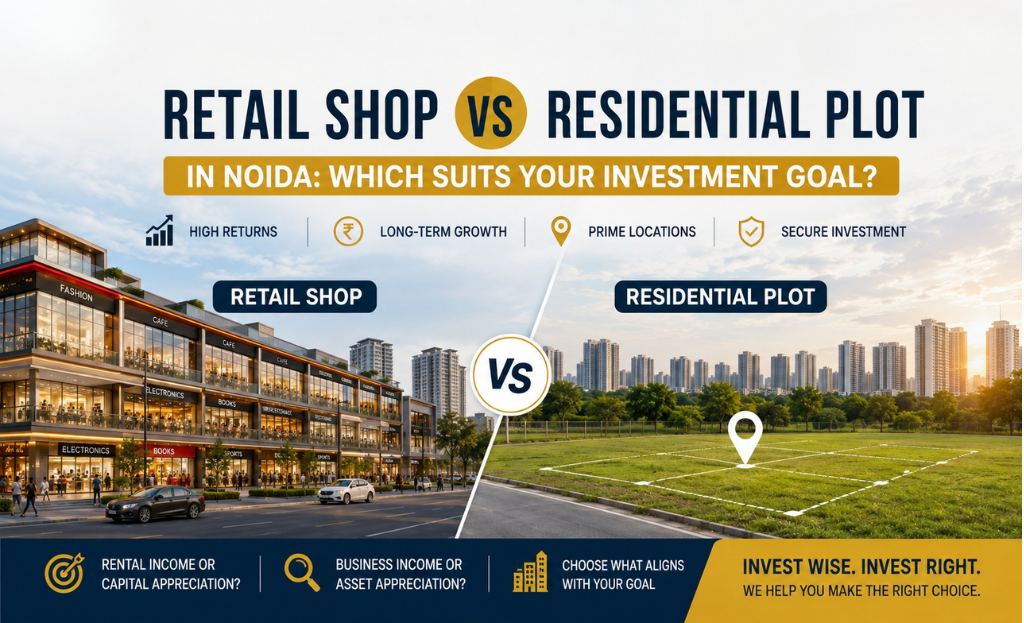
If your main question is simple—which is better, a retail shop or a residential plot in Noida?—the short answer is this: a retail shop may suit investors seeking possible rental income sooner, while a residential plot may suit investors prioritising flexibility and a longer holding horizon. The better choice depends less on hype and more on your budget, approval comfort, cash-flow needs, and willingness to manage the asset.
For an investor comparing Noida shop vs plot investment, the two property types behave differently. A shop is usually an income-led commercial asset. A plot is usually a land-led asset where value may depend more on location, infrastructure progress, and future use. Neither is universally superior. Each comes with distinct entry costs, documentation checks, holding costs, and exit challenges.
Noida and nearby growth corridors continue to attract attention because of transport links, planned expansion, and commercial development. Research referenced for this article suggests that plotted developments in and around Greater Noida and the Yamuna Expressway corridor remain popular with buyers seeking flexibility and longer-term value, while retail space in Noida is often viewed as a strong commercial category because of population growth, metro connectivity, and rising business activity. These are market observations, not guarantees.
At a glance: retail shop vs residential plot
| Factor | Retail Shop | Residential Plot |
|---|---|---|
| Primary objective | Potential rental income and commercial exposure | Land ownership, future construction, or longer-term hold |
| Income from day one | Possible, if tenant demand exists and the unit is lease-ready | Usually limited unless later developed or used in a permitted format |
| Approvals complexity | Higher due diligence on commercial use, occupancy, lease terms, maintenance structure | Strong need to verify title, land use, authority approvals, and buildability |
| Management effort | Can be active, especially if tenant turnover is frequent | Usually lower while vacant, but monitoring and boundary protection matter |
| Yield profile | Commercial assets are commonly viewed as having higher rental yield potential than residential assets, though outcomes vary | Vacant plots generally do not produce regular rental income |
| Liquidity | Can depend heavily on project quality, footfall and lease status | Can depend on micro-market demand, plot size and legal clarity |
| Best fit | Investors wanting income focus and commercial diversification | Investors wanting optionality and a patient time horizon |
Cost and entry barrier: what you are really paying for
When investors compare a shop with a plot, they often focus only on the base price. That is incomplete. The real comparison should include all-in acquisition cost, fit-out or development cost, carrying cost, and time to usability.
Retail shop: more than the purchase price
A retail shop may involve not only the asset cost, but also charges linked to maintenance, common area upkeep, fit-out readiness, signage rules, lease brokerage, and vacancy periods. In many cases, your income potential depends on whether the location already has footfall, whether the catchment supports daily retail, and whether the project is operational rather than purely marketed as future potential.
For a shop, investors are often paying for:
- Commercial location and visibility
- Existing or expected footfall
- Tenantability of unit size and frontage
- Project management standards and upkeep
- Branding value of the complex or sector
That means a cheap shop is not automatically a better deal. If the retail mix is weak or the catchment is immature, leasing may take longer than expected.
Residential plot: lower ongoing overhead, but hidden diligence cost
A residential plot may look simpler because there is no built structure to inspect in the same way. But legal and planning checks become even more important. A plot buyer is effectively paying for land, location, development potential, and future optionality. Research in the supplied material indicates that Noida-linked plotted corridors, including Greater Noida and the Yamuna Expressway belt, attract investors because of planned growth and relative affordability versus some other NCR pockets. Still, that is a broad market theme, not a property-specific conclusion.
With a plot, your total cost analysis should include:
- Authority dues or transfer-related charges, where applicable
- Boundary and site security cost
- Holding period without income
- Future construction cost if you plan to build
- Delay risk if surrounding infrastructure develops slower than expected
So, on pure cash-flow grounds, a plot can be easier to hold than an underperforming commercial shop, but it may also remain a non-income asset for a long period.
Approvals and due diligence: where investors make costly mistakes
If your priority is safety of transaction, both options require disciplined checking—but the nature of the checks differs.
What to verify before buying a retail shop in Noida
- Project status and usage: Confirm that the unit is approved for commercial retail use and not being represented loosely.
- Completion and occupancy-related documents: Check what is already in place and whether the unit is operationally usable.
- Developer or seller title: Ensure the seller has the right to transfer the unit and that past dues are disclosed.
- Common area and maintenance terms: These directly affect tenant appeal and your net income.
- Lease viability: Ask for actual footfall evidence, nearby anchor activity, and vacancy levels in the same block if available.
One common investor error is treating every mall or mixed-use project as equal. In reality, the difference between a well-traded retail cluster and a low-activity project can be substantial.
What to verify before buying a residential plot in Noida or Greater Noida
- Title chain and transferability: Verify ownership and whether the plot can be legally transferred.
- Land use: Confirm that it is residential and not represented contrary to planning norms.
- Authority approval and layout status: Check whether the plotted development is part of an approved scheme or layout.
- Physical demarcation: Match the site on ground with the documents and sanctioned plan.
- Access and infrastructure readiness: Road access, drainage, electricity and surrounding development affect usability and future resale.
With plots, investors sometimes assume “land is safer because it is tangible”. That is only partly true. A plot with unclear documentation or mismatched land use can be harder to monetise than a smaller but cleaner built asset.
If you need help comparing documentation, resale options or leasing readiness, a structured advisory process can reduce guesswork. Contextually, investors often use complete property solutions when evaluating multiple asset classes across purchase, resale and leasing stages.
Rental yield and income potential: the biggest practical difference
This is where the choice becomes clearer for most investors. A retail shop generally has stronger direct rental intent than a residential plot. The supplied research includes the broad market view that commercial properties such as retail shops usually generate higher rental yields than residential property categories. That is directionally useful, but yield is never automatic.
Retail shop income potential
A shop can generate rent if:
- The micro-market has enough consumer activity
- The unit size matches typical tenant demand
- The project has visible access, parking support, and operational occupancy
- The lease terms are realistic for the local market
In established commercial areas, this may create a more income-oriented holding. Research also points to key Noida commercial pockets such as Sector 18 as a retail core and Sector 62 as an established office hub. Those references help frame market structure, but a unit-level decision should still be made only after inspecting the exact project and catchment.
Residential plot income potential
A vacant residential plot usually does not provide regular rental income in the same way a shop can. It may become income-generating only if you later build on it, use it in a legally permitted way, or exit at a favourable resale stage. Therefore, if your main objective is monthly cash flow, a plot is often the less direct route.
However, some investors still prefer plots because:
- They do not want tenant management immediately
- They value future construction flexibility
- They are comfortable with a longer investment cycle
- They want lower wear-and-tear risk than a built commercial unit
Risk, liquidity and time horizon
Retail shop risks
- Vacancy risk: No tenant means no income, while expenses may continue.
- Footfall risk: The project may not sustain expected commercial activity.
- Lease concentration risk: Your return may depend on finding the right tenant profile.
- Operational dependency: The wider complex must remain active and maintained.
That said, a leased shop in a functioning location may appeal to investors who want visibility on potential cash flow.
Residential plot risks
- Idle capital risk: Money may remain parked without regular income.
- Execution risk: Future value often depends on local development progress.
- Documentation risk: Title, approvals and demarcation errors can affect resale.
- Encroachment or upkeep risk: Vacant land needs periodic monitoring.
On liquidity, there is no universal winner. A well-located, correctly priced plot can sell faster than a weak commercial unit. Equally, an income-generating shop may attract buyers faster than a plot in an underdeveloped pocket. Liquidity is market-specific, not asset-type specific.
Which investor profile suits each option?
A retail shop may suit you if
- You want possible rental income rather than only land exposure
- You are comfortable reviewing commercial lease economics
- You can tolerate vacancy periods
- You prefer an asset with business-linked upside rather than pure land optionality
A residential plot may suit you if
- You have a longer time horizon
- You value flexibility to build later or hold land
- You prefer fewer day-to-day tenant issues initially
- You are disciplined about title and planning checks
Actionable checks before you decide
Use this shortlist before putting money into either asset class:
- Define the goal first: Is your priority income, capital preservation, future construction, or diversification?
- Set a holding horizon: Less than 5 years and more than 5 years can lead to very different choices.
- Inspect the exact micro-market: Do not buy only on corridor-level stories.
- Demand primary documents: Title, approvals, payment history, transfer terms and usage status should be checked in writing.
- Stress-test vacancy or delay: Can you comfortably hold the asset if leasing takes time or if development progress slows?
- Compare exit options: Ask who the likely next buyer is—end-user, investor, retailer or builder.
Final view
For most investors, the practical distinction is straightforward. If you want a property with clearer rental intent, a retail shop is usually the more direct choice. If you want flexibility, lower active management at the start, and patience for future value creation, a residential plot may be the better fit.
In Noida, both categories can look attractive because of infrastructure-led growth narratives and expanding urban catchments. But the decision should not rest on broad claims alone. It should rest on documented approvals, realistic holding capacity, and whether you want income now or optionality later.
So, in the Noida shop vs plot investment debate, buy the asset that matches your strategy—not the one that sounds more exciting in marketing material.
Frequently asked questions
Is a retail shop in Noida better than a residential plot for rental income?
Usually, yes. A retail shop is generally bought with leasing potential in mind, while a vacant residential plot typically does not produce regular rent unless it is later developed or used in a permitted format. Actual income still depends on location, demand and documentation.
Which requires more approvals and due diligence: a shop or a plot?
Both require careful checks, but the focus differs. A shop needs verification of commercial use, operational status, maintenance structure and lease viability, while a plot needs strong title, land-use, approval and demarcation checks. Investors should avoid treating either asset as simple by default.
Are residential plots in Noida and Greater Noida suitable for long-term investors?
They may suit long-term investors who value flexibility and can hold without immediate income. The supplied research indicates continued interest in plotted corridors around Greater Noida and the Yamuna Expressway due to planned growth and connectivity themes. That remains a market view, not a certainty for every plot.
What is the biggest risk when buying a retail shop in Noida?
The biggest practical risk is vacancy or weak tenant demand despite a promising brochure. Footfall, tenant mix, project maintenance and accessibility matter far more than headline marketing. A commercially approved unit is not automatically a well-performing retail asset.
How should an investor choose between the two?
Start with your objective. If you want possible income and commercial exposure, a retail shop may fit better; if you want land ownership, patience and future build flexibility, a residential plot may fit better. The final decision should follow document checks, site visits and realistic holding capacity.
Sources checked
Send us your property requirement
Prefer not to call? Complete the form and the Aditya Estates team will contact you.


