
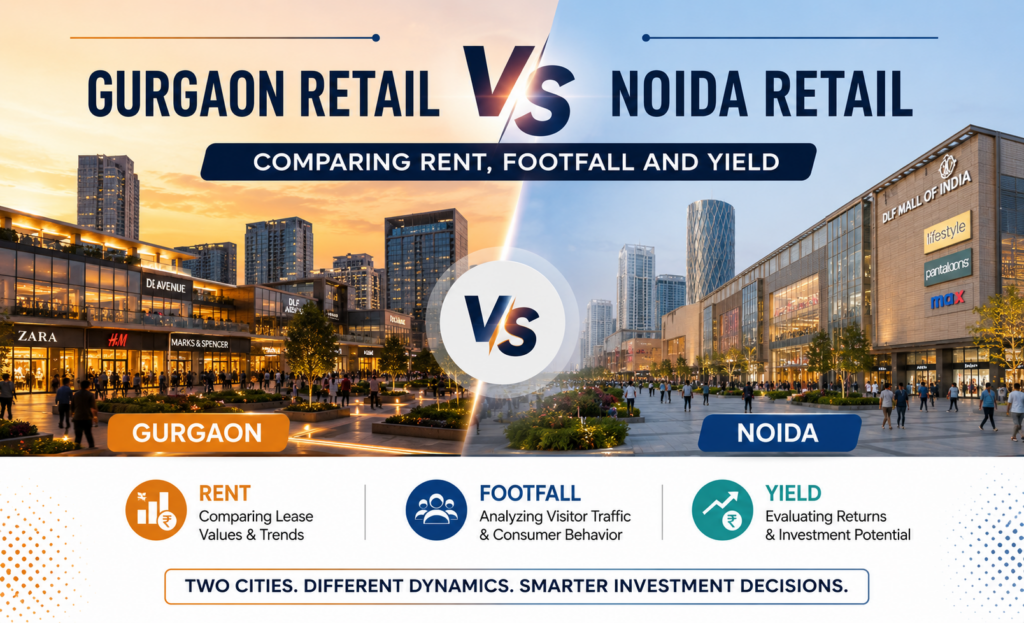
For most store owners comparing Noida vs Gurgaon retail rent, the short answer is this: Gurugram typically commands higher rents and may support stronger rental yield in well-established commercial pockets, while Noida usually offers lower entry costs and more budget-sensitive demand. That does not automatically make one market better than the other. If your business depends on affluent office-led catchments, destination retail and premium brand positioning, Gurugram often looks stronger. If your priority is lower occupancy cost, wider price-sensitive footfall and potentially easier entry, Noida can be the more practical choice.
The decision should not be made on headline rent alone. Retail performance depends on the exact micro-market, mall or high street, access, parking, anchor mix, competing supply, surrounding housing density, office presence and how your product is priced. A unit in a top Gurugram mall and a shop in a local Noida market serve very different demand pools.
Available market commentary broadly supports this direction. Cushman & Wakefield notes that rentals in Delhi NCR improved modestly, by around 1–2% quarter-on-quarter and 3–4% year-on-year in the referenced period. Other cited reports and market articles suggest Gurugram remains one of NCR’s costlier and stronger rental-demand markets, while Noida tends to be relatively more affordable. Some secondary sources also place Gurugram’s rental yield slightly above Noida’s, though such figures vary by asset type and source and should be treated as indicative rather than definitive.
At a glance: Gurgaon retail vs Noida retail
| Factor | Gurugram | Noida |
|---|---|---|
| Typical market positioning | Premium, corporate-led, brand-heavy pockets in many established zones | Value-conscious to mid-market, with select organised retail clusters |
| Occupancy cost pressure | Usually higher | Usually lower |
| Footfall profile | Can be stronger in office belts, destination malls and affluent catchments | Can be broader in family and price-sensitive neighbourhood markets |
| Entry affordability | Generally less affordable | Generally more affordable |
| Yield expectation | Often perceived as stronger in prime assets, but varies sharply by location | Can be competitive where acquisition cost is lower, but not uniform |
| Best suited for | Premium retail, dining, lifestyle, client-facing brands | Everyday retail, value formats, neighbourhood services, cost-conscious operators |
How rental yield should be viewed in retail property
Retail rental yield is usually understood as the annual rent earned relative to the property cost. In practice, however, comparing yield across Gurugram and Noida is not straightforward. A mall shop, a high-street unit and a neighbourhood market property all behave differently. Lease structures, fit-out burden, vacancy risk, maintenance outgo, revenue share clauses, signage visibility and tenant profile all affect the effective outcome.
That is why broad market numbers can only be used as a starting point. Some of the research summaries provided indicate that Gurugram may deliver somewhat higher rental yields than Noida in certain comparisons, while others show Noida as competitive in specific residential-led yield studies. Since these figures come from mixed source types and may refer to different asset classes, periods or assumptions, it is safer to conclude that Gurugram often has stronger rent-paying capacity in prime commercial belts, whereas Noida may benefit from lower entry pricing. Your realised yield could be better in either city depending on where and what you buy or lease.
Gurugram retail: where the case gets stronger
Gurugram’s main strength is its commercial ecosystem. The city has a deep corporate base, established business districts and a concentration of higher-spending office users and resident catchments in many micro-markets. Several secondary sources in the research set describe Gurugram as one of NCR’s strongest rental markets, supported by business concentration and premium positioning.
Why retailers choose Gurugram
- Higher spending capacity in many catchments: Premium residential clusters and office zones can support discretionary retail, food and beverage and lifestyle formats.
- Brand visibility: For businesses that need signalling value, a Gurugram address may help with positioning.
- Organised retail depth: Destination malls, mixed-use developments and branded high streets can draw stronger non-local traffic.
- Client-facing appeal: Businesses targeting office professionals, expats or premium consumers may find a better fit here.
Where caution is needed
- Higher rent and deposit burden: Even good sales can get squeezed if occupancy costs are too high.
- Competition can be intense: Better-known clusters usually attract more brands and comparable substitutes.
- Footfall quality matters more than raw volume: A premium location is not useful if your price point does not match the audience.
For a tenant, this means Gurugram may be worth paying for if your margins can absorb the cost and your category depends on affluent repeat buyers or office-led lunch and evening traffic. For an owner, a good Gurugram retail asset may attract stronger tenants, but the acquisition cost can also be substantially higher.
Noida retail: where value and practicality stand out
Noida’s case is usually built on affordability and a broader value-led consumer base. Some of the research summaries clearly indicate that Noida remains more budget-friendly than Gurugram in general rental comparisons, and this cost advantage often matters in retail. Lower occupancy cost can improve survival odds for operators in categories with tighter margins.
In a comparison that mentions Sector 18 and Sector 92, it is important to distinguish between destination market retail and neighbourhood-driven retail. Sector 18 is a long-recognised Noida retail zone with strong visibility and mixed consumer traffic. Sector 92, by contrast, would usually be assessed more as a catchment-led market where residential density, daily-needs demand and local convenience spending become more important than citywide destination appeal.
Why retailers choose Noida
- Lower entry barrier: For many businesses, lower rent improves flexibility during the first 12 to 24 months.
- Wider mid-market demand: Value retail, services, clinics, convenience stores, coaching, salons and family dining can perform well in the right sector markets.
- Residential catchment dependence: Neighbourhood retail can benefit from repeat local consumption.
- Better cost control: Businesses focused on operational efficiency may prefer Noida over costlier western NCR options.
Where caution is needed
- Not every market is destination retail: Some sectors rely heavily on local catchment and may not support premium rents.
- Yield can look attractive only if occupancy is stable: A cheaper asset is not automatically better if leasing velocity is weak.
- Micro-market quality varies sharply: Main-road frontage, parking and surrounding density can make or break performance.
Footfall comparison: mall traffic vs market traffic
Footfall is one of the most misunderstood retail metrics. More people do not always mean better sales. A grocery-led neighbourhood market may have reliable daily visitors but lower bill values. A premium mall may see fewer conversions in some categories but stronger average ticket size.
In broad terms, Gurugram often favours premium mall and office-adjacent footfall, while Noida can offer stronger value-oriented and local-family footfall in the right sectors. If you are comparing a Gurugram mall with Noida Sector 18, ask whether your product needs destination shoppers or frequent local shoppers. If you are comparing Gurugram high street with Noida Sector 92, the right question is whether your business needs city-level draw or neighbourhood repeat demand.
Use these practical filters before signing:
- Observe footfall at three times: weekday lunch, weekday evening and weekend peak.
- Count category-relevant traffic: not all visitors are your potential customers.
- Check conversion drivers: parking, escalator placement, frontage width, signage and adjacent anchors.
- Study dwell time: food, fashion and services respond differently to short visits and destination trips.
- Ask existing occupiers about dead hours: headline busy periods can hide weak trading windows.
What this means for rental yield comparison
If you are an investor or owner looking only at rental yield, Gurugram may appear stronger in many premium retail scenarios because rents can be higher and tenant demand may be deeper in established commercial corridors. Some secondary references in the research set point to Gurugram yields around or above Noida in broad city comparisons. However, those are city-level generalisations.
Noida can still make sense when capital values are lower, leasing risk is manageable and the retail format is tightly matched to local demand. In other words, lower rent does not necessarily mean weaker yield if the acquisition cost is proportionately lower and occupancy remains stable. Conversely, a high-rent Gurugram asset can underperform if purchased at too high a price or leased in an over-supplied cluster.
So the more useful conclusion is this:
- Choose Gurugram if you want stronger premium demand, office-linked consumption and brand-led positioning, and if the economics still work after all outgoings.
- Choose Noida if you want lower entry cost, more controlled occupancy expense and a format suited to local or mid-market demand.
Actionable checklist before you finalise a shop
Whether you lease or buy, do these checks on the ground:
- Measure effective rent, not just base rent: include CAM, fit-out amortisation, common-area charges, taxes where applicable and revenue-share clauses if any.
- Map catchment within 1 km, 3 km and 5 km: residential density, offices, schools and competing markets all matter.
- Review tenant mix: anchor stores can lift traffic, but the wrong neighbour mix can dilute your audience.
- Inspect visibility: a cheaper upper-floor or inward-facing unit may save rent but reduce walk-ins.
- Check parking and entry friction: difficult access can materially cut repeat visits.
- Assess vacancy pattern: too many recent exits may indicate a deeper market issue.
- Match format to market: premium products in a value market, or discount formats in a luxury cluster, often struggle.
If you want help evaluating live leasing options across NCR retail pockets, Aditya Estates’ rent or leasing services may help you compare locations, occupancy costs and fit for your business requirements.
Final takeaway
On the question of Noida vs Gurgaon retail rent, Gurugram generally leads on pricing power, premium positioning and office-backed demand, while Noida remains attractive for affordability, operational discipline and neighbourhood-driven retail. For many commercial tenants, the right choice is not the city with the higher headline rent or the better citywide yield narrative. It is the micro-market where your target customer already spends, your occupancy cost remains sustainable and your shop format fits the footfall profile.
That is why a careful site-by-site comparison matters more than city branding. In retail, the winning decision is usually local, not generic.
Frequently asked questions
Is Gurgaon better than Noida for retail rental yield?
In broad market commentary, Gurugram is often seen as stronger for premium rental demand, especially in established commercial zones. But actual retail yield depends on the exact asset, purchase cost, lease terms and vacancy risk, so the better result can come from either city at the micro-market level.
Does higher footfall always mean better retail performance?
No. Retail performance depends on relevant footfall, not just total footfall. A smaller but better-matched audience can outperform a busier location if spending power, conversion and repeat visits are stronger.
Is Noida more suitable for budget-sensitive retail formats?
Often, yes. Noida is generally considered more affordable than Gurugram, which can help businesses that need lower occupancy costs or depend on mid-market and neighbourhood demand. The exact suitability still depends on the sector, frontage and local competition.
What should a commercial tenant compare before signing a retail lease?
Compare effective rent, maintenance charges, visibility, parking, catchment profile, competing supply and the track record of nearby tenants. It is also useful to observe weekday and weekend traffic and ask how the location performs during slow hours, not just peak periods.
Sources checked
Send us your property requirement
Prefer not to call? Complete the form and the Aditya Estates team will contact you.