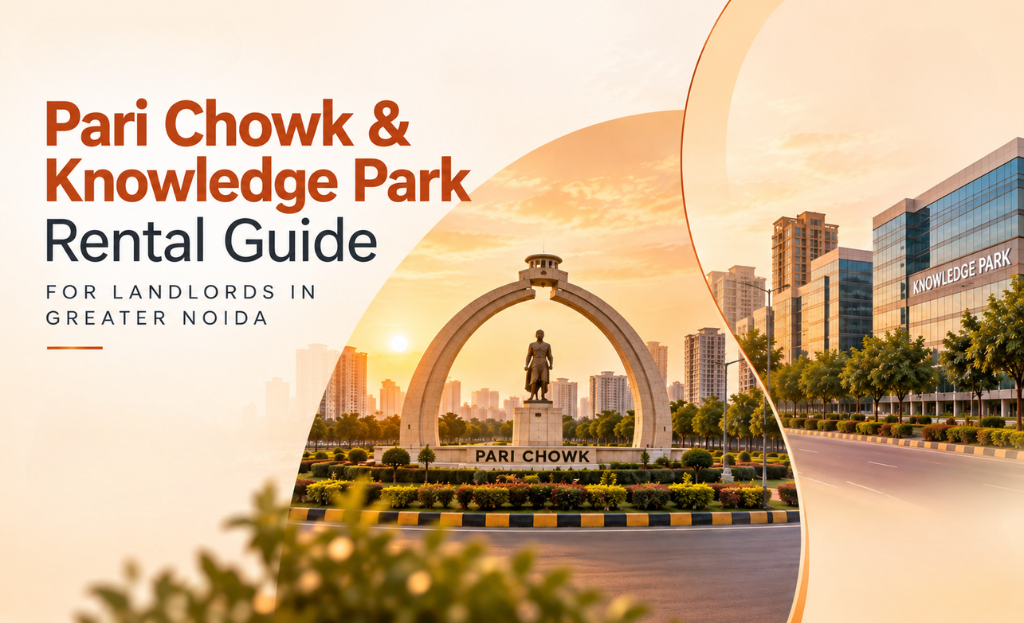
If you are evaluating the Pari Chowk and Knowledge Park rental guide question as a landlord, the short answer is this: the micro-market works best when you match the property to its likely tenant profile. Around Pari Chowk and the Knowledge Park belt, rental demand is supported by educational institutions, daily commuting needs and nearby commercial activity. That usually makes compact homes, shared accommodation formats and practical family units more relevant than highly niche inventory.
At the same time, this is not a one-size-fits-all rental pocket. Knowledge Park 1, 2 and 3 serve different use cases, while Pari Chowk acts as a wider access node for Greater Noida. A landlord should therefore assess distance to institutions, approach roads, metro or bus access, market convenience, building upkeep and tenant turnover risk before setting expectations on occupancy or rent.
Why this micro-market matters to landlords
Pari Chowk is widely recognised as a key junction in Greater Noida, with links to the Noida-Greater Noida Expressway and other arterial roads. The research also indicates that surrounding localities include Alpha I, Omega II and Knowledge Park-I, with established residential projects in the wider catchment. In practical terms, that matters because tenants often search by commute convenience first and exact society second.
Knowledge Park, meanwhile, is closely identified with colleges, universities, hostels and healthcare access. Research summaries mention educational institutions and nearby hospitals in and around Knowledge Park 1, while Knowledge Park 3 is described as being behind Sharda University and near Jagat Farm, with access to daily needs. For landlords, this combination typically supports recurring demand from students, academic staff, healthcare-linked professionals and entry-level working tenants.
That said, demand quality can vary. Student-led rental demand may create faster absorption for rooms or smaller flats, but it may also mean higher wear and tear, more frequent move-ins and move-outs, and stronger seasonality around academic cycles. Family tenants may stay longer, but they often prioritise quieter pockets, parking, lift reliability, maintenance standards and grocery access over pure proximity to campus.
Understanding the rental demand pockets
1) Knowledge Park 1: Institution-led demand
Based on the research, Knowledge Park 1 is associated with direct access, colleges , universities, hostels, and nearby healthcare infrastructure. That usually makes it relevant for:
- Students seeking lower travel time to campus
- Parents arranging supervised or semi-supervised accommodation
- Teaching staff and junior professionals looking for practical weekday commuting
- Small landlords offering room-by-room or compact flat rentals
For this pocket, landlords should pay close attention to furnishing strategy. A fully bare unit may attract fewer student tenants than a basic ready-to-use setup with wardrobes, fans, geyser, study arrangement and reliable internet provision options.
2) Pari Chowk: Transit-led and mixed demand
Pari Chowk functions more as a gateway and movement hub than a purely residential cluster. The area benefits from wide roads and strong road connectivity, according to the evidence. Because of this, tenants who work elsewhere in Greater Noida or commute towards Noida may still consider nearby stock if the last-mile trip is manageable.
For landlords, this often means mixed demand rather than a single tenant type. You may see interest from:
- Working professionals who value road access
- Families preferring established sectors around the junction
- Students who want better connectivity than deeper interior pockets
- Commercial users looking at nearby office or service space in the broader zone
3) Knowledge Park 2 and 3: Spillover from campus and commercial activity
The research shows verified commercial rental listings in Knowledge Park 2 and Knowledge Park 3, including office space references and proximity to Pari Chowk. This does not automatically prove uniform commercial demand across every building, but it does suggest that parts of the belt attract non-residential movement and service-sector activity.
For residential landlords, that can be positive when managed well. Areas with office, institutional and support-service activity may create demand for studio units, shared flats and short-commute rentals. But you should also check whether noise, traffic, delivery movement or parking pressure reduce appeal for family tenants.
Commute, access and liveability: what tenants usually assess first
In this micro-market, commute is central to leasing decisions. Research summaries identify Pari Chowk as a major junction and point to strong links with Noida through the expressway. Knowledge Park 3 is also described as being near Pari Chowk Metro Station in one locality summary. However, landlords should verify current station access, feeder availability and actual walking or ride times on the ground rather than relying on broad area labels alone.
A practical point from the research: one source notes that standard Delhi Metro smart cards may not be compatible in the way some users assume on the Aqua Line ecosystem. This is a small but useful reminder that tenant convenience depends on real commuting behaviour, not just map distance.
When a prospective tenant visits, they are usually evaluating the following:
- How long it takes to reach campus, office or coaching centres
- Availability of autos, e-rickshaws and app-based transport
- Road quality and lighting on the final stretch
- Nearby grocery, pharmacy and food options
- Safety perception during early morning or late evening hours
- Internet stability and mobile network performance inside the building
If you are leasing out a unit in this belt, you may benefit from documenting these basics in your listing. A factual description often performs better than generic claims. For example, instead of saying “excellent connectivity”, mention the nearest landmark, likely route and whether the property is better suited for students, single professionals or small families.
Housing stock: what kind of property works here
The wider Pari Chowk catchment includes established residential projects as well as sector-based housing options in nearby localities. In and around Knowledge Park, inventory tends to be more use-case driven. In simple terms, landlords should think in terms of tenant fit rather than only unit size.
| Property type | Likely demand driver | Landlord watch-outs |
|---|---|---|
| Single room or PG-style format | Students and interns | Turnover, maintenance, utility management |
| Studio or compact 1BHK | Single working professionals, couples, faculty | Parking, furnishing level, storage space |
| 2BHK in organised society | Small families, shared professionals | Society maintenance, lift, power backup |
| Larger family units | Longer-stay households in selected pockets | Slower absorption if too far from daily conveniences |
| Commercial or office unit | Service businesses, support offices | Zoning, fit-out cost, vacancy cycles |
Research snapshots also indicate some commercial leasing activity in Pari Chowk, Knowledge Park 2 and Knowledge Park 3, and an industrial or warehouse-oriented listing in Knowledge Park 5. That should be read carefully. It suggests the broader Greater Noida Knowledge Park belt is not purely residential, but it does not mean every sub-pocket is equally suitable for commercial leasing.
Actionable checks before you price your rental
Landlords often lose time not because demand is weak, but because pricing and positioning are unclear. Before putting a unit on the market, check the following:
- Walk the last 300 to 500 metres: The final approach road, street lighting and drain condition can strongly affect tenant decisions.
- Test the actual commute: Travel to Pari Chowk, a nearby university gate or the expected workplace during peak hours.
- Check building management standards: Ask about water supply, power backup, security guard presence and complaint resolution.
- Audit your furnishing level: In student-heavy belts, practical furnishing can influence occupancy more than decorative upgrades.
- Assess noise and crowd patterns: Visit both daytime and evening. A quiet lane at noon may be congested at night.
- Map essential services: Grocery, pharmacy, clinic and food outlets within easy reach improve rental appeal.
- Review tenant fit honestly: A family-oriented unit should not be marketed like student accommodation, and vice versa.
If you need help comparing tenant profiles, documentation flow and on-ground positioning, a structured leasing service can reduce mismatch risk. Aditya Estates’ rent or leasing services page is relevant for landlords who want support with this process.
Commercial spillover and what it means for small owners
One of the more interesting features of this belt is the overlap between education, transit and commercial movement. Office and commercial listings referenced in the research around Pari Chowk and Knowledge Park 2 and 3 indicate some level of business activity in the area. For a small owner, this can influence residential leasing in two opposite ways.
- Positive effect: more footfall, more service demand, stronger need for nearby rentals for staff and support workers.
- Negative effect: parking stress, uneven quiet hours, cluttered frontage and faster wear on shared infrastructure.
The right takeaway is balance. If your property sits near a high-movement corridor, you may do better with practical tenants who value access over serenity. If your unit is in a more inward, maintained residential pocket, you may have better chances with families or longer-stay sharers.
Risks and limits landlords should acknowledge
No rental micro-market is risk-free. In the Pari Chowk and Knowledge Park belt, the main landlord risks may include:
- Seasonal vacancy if student demand weakens temporarily
- Higher maintenance needs in heavily used units
- Mismatch between asking rent and on-ground building quality
- Overestimating commute convenience based on map labels alone
- Safety perception differences between main road and inner lane locations
One research source cites locality ratings for connectivity and safety in the broader Knowledge Park area, with connectivity stronger than safety perception. This should not be treated as a definitive safety assessment, but it does reinforce the need for landlords to verify lighting, access control and neighbourhood behaviour themselves.
Bottom line for landlords
Pari Chowk and the Knowledge Park belt can be a workable rental micro-market for landlords who understand the area’s mixed demand base. The strongest case usually comes from proximity to institutions, practical access routes and day-to-day convenience. Small, efficient and correctly positioned units may perform more consistently than over-specified inventory.
For owners, the key is not to treat the entire belt as one homogenous market. A unit near campus, a flat near a transit node and a property influenced by commercial activity may all attract different tenants and require different leasing strategies. Careful on-ground checks, realistic positioning and tenant-fit thinking are likely to matter more here than broad market claims.
Frequently asked questions
Is Pari Chowk or Knowledge Park better for rental demand?
They serve slightly different demand patterns. Knowledge Park is more institution-led, which may suit student and academic-linked rentals, while the Pari Chowk area benefits from wider connectivity and mixed tenant profiles. The better location depends on whether your property is aimed at students, working professionals or families.
What kind of rental unit is usually easier to let in this belt?
Compact, practical units often have wider appeal in this micro-market, especially where commute and campus access matter. However, the exact fit depends on the lane, building quality, furnishing level and nearby conveniences. A larger unit can still work if it is in a well-managed residential pocket.
Should landlords expect only student tenants around Knowledge Park?
Not necessarily. Student demand is important, but nearby healthcare, commercial activity and city connectivity can also attract faculty, staff, junior professionals and shared-family tenants. The tenant mix tends to vary by sub-location and building type.
How should a landlord verify commute convenience before listing?
Do not rely only on area names or map pin distances. Travel the route yourself during peak hours, check auto or e-rickshaw availability, and confirm access to the actual institution, metro point or workplace that your target tenant will use. Last-mile convenience often affects decision-making more than broad connectivity claims.
Sources checked
Send us your property requirement
Prefer not to call? Complete the form and the Aditya Estates team will contact you.