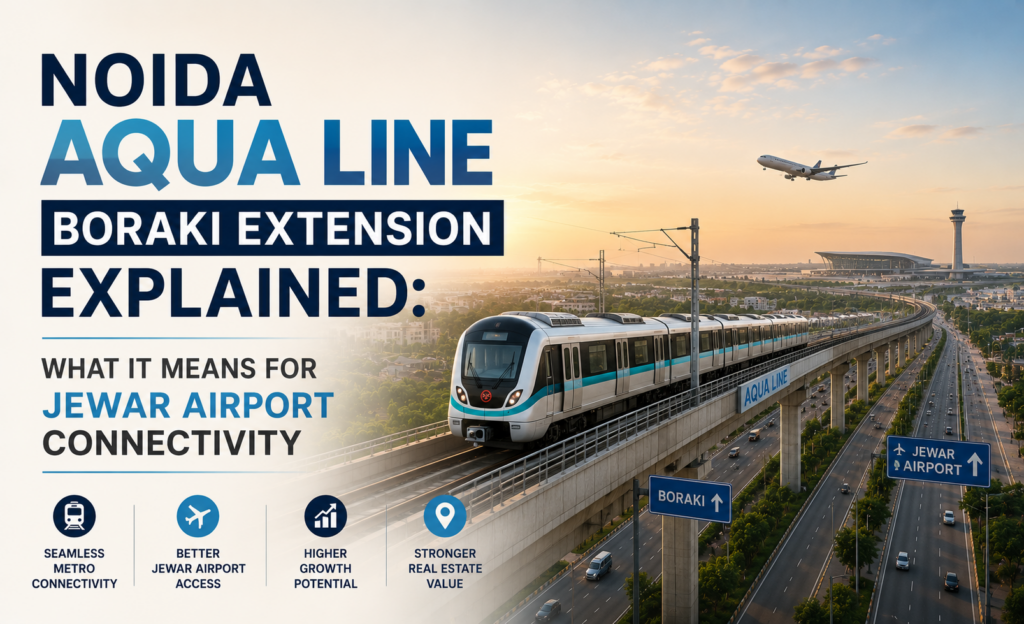
The Noida Aqua Line Boraki extension is a proposed 2.6 km elevated addition to the existing Aqua Line, running from Depot Station to the Boraki multi-modal transport hub in Greater Noida. It is expected to add two stations: Junpat and Boraki. The central government has cleared the project, according to reports.
For commuters and property buyers, the important distinction is simple: this is not a direct Aqua Line metro connection to Jewar airport. Instead, it is intended to bring the metro network to Boraki, where rail, bus and other regional transport connections are planned or envisaged. Airport access would still depend on the eventual interchange arrangement and the available onward mode from Boraki.
The extension matters because it could make Boraki a more connected interchange point within the wider Greater Noida–Jewar travel network. However, homebuyers and investors should assess it as an approved infrastructure project with execution milestones still to be tracked, rather than treating airport connectivity as already operational.
What exactly is the Boraki extension?
The Boraki project extends the Aqua Line beyond its existing Depot Station towards the proposed Multi-Modal Transport Hub (MMTH) at Boraki. Public reports describe the corridor as a 2.6 km elevated route with two new stops:
- Junpat
- Boraki
Reported project information places the cost at about ₹416 crore. This is a reported project estimate, not a final indication of actual construction cost. The India Investment Grid also lists an urban public transport project for the extension of the Aqua Line corridor from Depot Station to MMTH Boraki.
Boraki is significant because the multi-modal hub concept is designed around interchange: railways, inter-city and state bus services, and a rapid rail corridor have been discussed as part of the broader hub vision. The exact services, operating arrangements and opening sequence will need to be confirmed as individual projects progress.
How does it bring Jewar airport closer?
The phrase “airport connectivity” can be misleading if read as a promise of a one-seat metro journey. The Boraki extension is better understood as a regional access improvement, not an airport metro line.
Once the extension is built, an Aqua Line passenger may be able to reach Boraki by metro and then change to a future or available onward transport mode for the Jewar airport area. This could reduce dependence on a single road-based journey for some travellers. But the total convenience will depend on several practical factors:
- Whether the planned Boraki hub facilities are ready and operating when the metro opens.
- The final airport-bound service available from Boraki, including route, frequency, fare and baggage convenience.
- Interchange walking distance, accessibility features and ticketing integration.
- Travel time to Boraki from the passenger’s starting point on the Aqua Line.
- Road conditions for any final road-based leg to the airport.
Reports have described Boraki as being less than an hour’s drive from Jewar. That is a road-travel description, not a guaranteed metro travel time. Actual trip duration can vary substantially by traffic, interchange wait times and the future airport access service.
A useful way to read the airport-connectivity claim
| Claim | What the Boraki extension supports | What still needs confirmation |
|---|---|---|
| Metro access towards Boraki | A 2.6 km extension from Depot Station, with Junpat and Boraki stations reported | Construction start, commissioning date and operating timetable |
| Access to a transport hub | Connection to the proposed Boraki MMTH | Which hub modes will be ready and how they will interchange |
| Jewar airport travel | A potential regional interchange route towards the airport area | A direct, seamless airport-bound service and end-to-end journey time |
Where this fits within wider Aqua Line expansion
The Boraki link is one part of a larger expansion discussion around the Aqua Line. Separately, an approximately 11.56 km extension between Botanical Garden and Sector 142 has been reported, with eight new stations mentioned in coverage. Reports also say the Botanical Garden–Sector 142 and Depot–Boraki projects were moving towards tendering.
These are distinct corridors and should not be merged into one assumed route. The Botanical Garden–Sector 142 proposal is relevant to commuters seeking better interchange with Delhi Metro at Botanical Garden. The Depot–Boraki extension is relevant to access towards the eastern Greater Noida transport hub. A passenger’s eventual end-to-end route will depend on which extensions are completed, their opening dates, and the connections available at each interchange.
Aqua Line use has also grown over time. Reported average daily ridership was 63,079 in January 2026, compared with 11,625 when the service opened in January 2019. Higher usage can underline the importance of additional connections, but it does not by itself establish future capacity, service frequency or property-price outcomes around the proposed stations.
What the project could mean for nearby property decisions
For investors, end users and landlords, a new metro proposal can change how a micro-market is perceived. Boraki and Junpat may gain attention because station access can improve daily mobility for some residents, workers and visitors. The longer-term relevance could be greater if the multi-modal hub develops as planned.
That said, a station announcement should not replace property-level due diligence. Metro-led demand can differ sharply by sector, road access, employment catchment, actual walking distance and the quality of last-mile transport. A plotted development advertised as “near Boraki Metro” may still be inconvenient if the approach road, footpath or feeder service is weak.
For purchasers evaluating homes in Greater Noida, it may be sensible to compare ready and resale options with proposed-infrastructure locations rather than relying on a single future connectivity narrative. You can review currently listed opportunities through resale property options where relevant, while independently verifying station proximity and project documentation.
Potentially positive, but not guaranteed, effects
- Better visibility for Boraki as a future transport-interchange location.
- An additional public-transport option for travellers already using the Aqua Line.
- Potentially improved access to parts of Greater Noida from the metro network.
- A broader connectivity narrative around Jewar airport and regional infrastructure.
What should not be assumed
- That the metro will run directly to the airport terminal.
- That a property has walkable access merely because it is in the Boraki or Greater Noida area.
- That all MMTH components will open together with the metro extension.
- That an approved project will meet a reported completion target without changes.
- That metro news alone will produce a specific rent, resale value or investment return.
Actionable checks before choosing a Boraki-area property
- Confirm the exact station relationship. Ask for the plotted location on a map and measure the realistic route to Junpat or Boraki, rather than relying on aerial distance or brochure language.
- Separate approved from operational. Check NMRC notices, tender updates, construction activity and official commissioning announcements before factoring metro use into a move-in plan.
- Verify the onward airport leg. If airport access is central to your decision, identify the actual future interchange mode, not just the claim that Boraki is linked to Jewar connectivity.
- Test the current journey. Visit the site at likely commute hours and assess road access to existing metro stations, rail facilities and major roads.
- Review the property independently. Check title-related records, sanctioned plans, possession status, maintenance obligations and any developer representations through appropriate professionals.
- Compare daily-use needs. Metro access is only one factor. Assess schools, healthcare, retail, employment routes, water supply, security and rental demand in the specific pocket.
Timeline: what is known and what remains uncertain
The key confirmed direction in reported coverage is that the Centre has cleared the Boraki extension. A three-year completion objective has been reported for the 2.6 km corridor, and some coverage has referred to 2028. These are planning or reported timelines, not a guarantee of opening.
Before treating any date as dependable, watch for tender award, contractor appointment, on-ground construction, system integration, trial runs and the formal opening notice. Infrastructure schedules can change because of approvals, land, procurement, funding, utility shifting or coordination with associated hub works.
The bottom line
The Noida Aqua Line Boraki extension is a compact but strategically important proposed connection: it takes the metro from Depot Station to Junpat and Boraki, placing the Aqua Line closer to a planned multi-modal interchange. Its strongest potential benefit is improved regional connectivity, including a possible future transfer path towards Jewar airport.
For a buyer or investor, the practical conclusion is to value the project for what it is today: an approved extension with two planned stations and a broader transport-hub rationale. Do not treat it as a completed direct airport metro link. Track execution, verify the final interchange design and evaluate each property on present-day fundamentals as well as future infrastructure potential.
Frequently asked questions
Is the Aqua Line being extended directly to Jewar airport?
No. Reported plans describe a 2.6 km Aqua Line extension from Depot Station to Boraki, not a direct metro line to the airport terminal. Boraki is intended as a multi-modal hub, so any airport journey would require an onward connection.
Which new stations are planned on the Boraki extension?
The reported two new stations are Junpat and Boraki. The corridor is described as an elevated 2.6 km extension from the existing Depot Station.
Has the Noida Aqua Line Boraki extension been approved?
Reports state that the central government has cleared the extension. Buyers should still track tender awards, construction progress and formal commissioning notices because approval does not mean the service is operational.
When will the Boraki metro extension open?
A three-year completion aim and a possible 2028 timeframe have been reported, but these are not guaranteed opening dates. Construction and commissioning milestones should be checked through official updates.
Will a Boraki metro station automatically increase property value?
There is no automatic or assured outcome. A station may improve a location's accessibility, but actual buyer demand and rents depend on the precise site, walkability, road access, surrounding development and the completed transport network.
Sources checked
Send us your property requirement
Prefer not to call? Complete the form and the Aditya Estates team will contact you.