
Aditya Estates, based in Noida Sector 18 in the Delhi NCR region > Blog > Uncategorized > 100–125 Acres of Pharma Opportunity: Noida Airport to Fuel a New Industrial Revolution!
100–125 Acres of Pharma Opportunity: Noida Airport to Fuel a New Industrial Revolution!
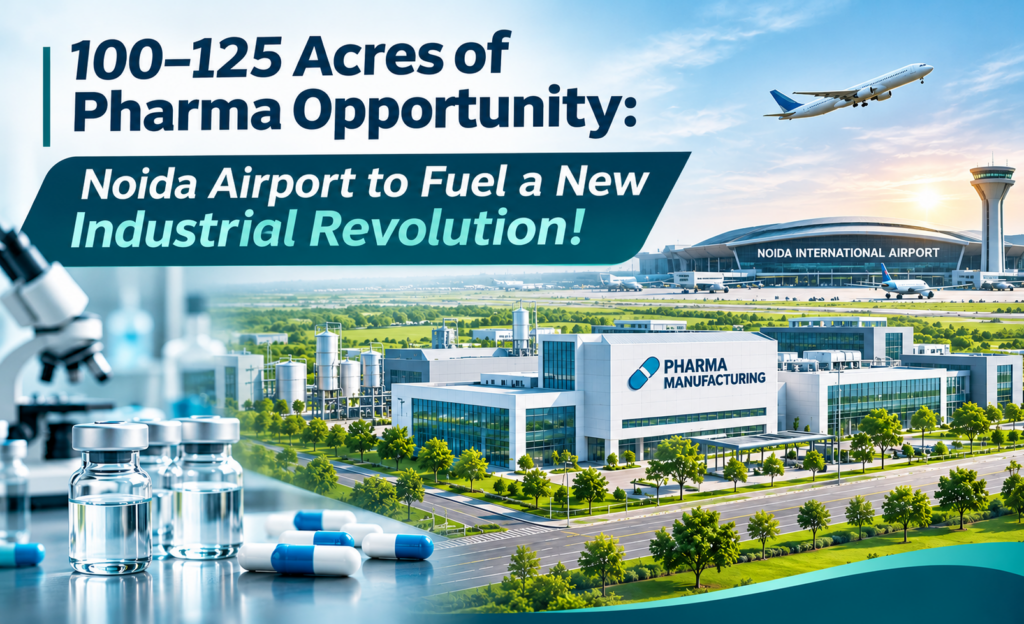
The Yamuna Expressway region is steadily gaining attention as an emerging destination for industrial development, infrastructure investment and commercial growth.
Adding another significant development to this growth story, the Yamuna Expressway Industrial Development Authority (YEIDA) has approved the reservation of approximately 100–125 acres of land in Sector 6 for a dedicated Pharmaceutical Formulation Manufacturing Cluster.
The decision was taken during YEIDA’s 92nd Board Meeting held on 17 August 2026.
Located within the broader Jewar Airport development region, this proposed pharmaceutical cluster is expected to attract domestic and international pharmaceutical manufacturers, encourage industrial investment and generate employment opportunities.
With Noida International Airport adding a new dimension to regional connectivity, the development could strengthen the industrial ecosystem of Greater Noida and the Yamuna Expressway belt.
Let’s understand what this development means and why it deserves attention.
1. YEIDA Approves a 100–125 Acre Pharmaceutical Manufacturing Cluster
One of the key highlights of YEIDA’s 92nd Board Meeting was the decision to reserve approximately 100–125 acres in Sector 6 for a dedicated Pharmaceutical Formulation Manufacturing Cluster.
The proposed cluster is intended to accommodate pharmaceutical companies involved in manufacturing finished dosage forms.
The planned manufacturing activities include:
Tablets and Capsules: Production of commonly used pharmaceutical medicines.
Injectables: Manufacturing of injectable pharmaceutical formulations.
Oral Liquids: Production of syrups, suspensions and other liquid medicines.
Topical Preparations: Manufacturing of creams, ointments and other external-use formulations.
Finished Dosage Forms: Other pharmaceutical products manufactured under applicable quality and safety standards.
The proposed manufacturing facilities are expected to follow national and international Good Manufacturing Practice (GMP) norms.
This initiative aims to create a dedicated industrial ecosystem for pharmaceutical formulation manufacturing rather than relying on scattered individual manufacturing facilities.
2. How Noida International Airport Could Strengthen the Pharmaceutical Industry
The pharmaceutical industry depends on more than manufacturing capacity. Efficient transportation, storage, distribution and supply-chain management are equally important.
This is where Noida International Airport at Jewar could play an important role.
The airport’s commercial passenger operations are scheduled to commence from 15 June 2026, according to the airport’s official announcement. The airport is also developing its air cargo ecosystem through partnerships aimed at expanding cargo operations.
For pharmaceutical manufacturers, improved airport connectivity could offer several potential advantages.
A. Better Access to International Markets
Air cargo connectivity could help pharmaceutical manufacturers transport high-value and time-sensitive products to international destinations, subject to available routes, cargo capacity and regulatory requirements.
B. Support for Temperature-Sensitive Medicines
Certain pharmaceutical products, including vaccines, insulin and biological medicines, require controlled temperature conditions during storage and transportation.
The development of specialised cold-chain facilities and temperature-controlled logistics services could become an important requirement for this ecosystem.
C. Improved Supply-Chain Efficiency
Better connectivity between manufacturing facilities, warehouses, distribution centres and airport cargo terminals could help companies manage transportation and delivery timelines more efficiently.
D. Opportunities for Pharmaceutical Exporters
As cargo infrastructure and international connectivity expand, manufacturers could gain improved access to export-oriented logistics solutions.
However, the actual benefits will depend on the availability of dedicated pharmaceutical cargo handling, cold-chain facilities and operational international cargo services.
3. Greater Noida and Yamuna Expressway: An Emerging Industrial and Healthcare Ecosystem
The proposed pharmaceutical cluster is part of a broader development strategy around the Jewar-Noida Airport region.
YEIDA has approved or earmarked land for several major industrial, healthcare and institutional developments.
Some important initiatives include:
Medical Device Park – Sector 28
A 350-acre Medical Device Park is being developed to support medical device manufacturing and related industries.
The park is intended to attract manufacturers involved in medical equipment, diagnostics and healthcare technology.
Medical Device Testing Facility
YEIDA has approved a proposal for a medical device testing facility within the Medical Device Park, aligned with the US FDA’s Accreditation Scheme for Conformity Assessment (ASCA).
The proposed facility is expected to support testing requirements such as electrical safety, electromagnetic compatibility, software validation and sterilisation.
Regional Medical Hub – Sectors 13 and 14
Approximately 500 acres have been earmarked for a proposed Regional Medical Hub.
The development is expected to support healthcare infrastructure, medical institutions and allied services.
University Township – Sector 14
A planned 480-acre University Township could strengthen the region’s education and institutional ecosystem.
Taiwan City – Sector 6
YEIDA has also reserved approximately 300 acres in Sector 6 for a proposed Taiwan City, with the objective of attracting investment in electronics, technology and manufacturing.
Together, these initiatives indicate a wider ambition to develop the Yamuna Expressway region as an integrated industrial, healthcare, educational and investment destination.
4. What Business Opportunities Could the Pharma Cluster Generate?
A dedicated pharmaceutical manufacturing cluster can create opportunities across multiple supporting industries.
Beyond the pharmaceutical companies themselves, several allied businesses could benefit from the development of this industrial ecosystem.
Potential business opportunities include:
Pharmaceutical packaging and labelling companies.
Industrial warehousing and storage facilities.
Cold-chain logistics and transportation providers.
Laboratory testing and quality assurance services.
Industrial machinery and equipment suppliers.
Raw material and component suppliers.
Distribution and supply-chain management companies.
Technical, maintenance and professional service providers.
For small and medium enterprises, the development could create opportunities to participate in the pharmaceutical manufacturing value chain.
The actual scale of business opportunities will depend on industrial allotments, investment commitments and the implementation timeline.
5. Employment Generation and Industrial Investment
The proposed cluster could attract established pharmaceutical companies as well as emerging manufacturers looking to expand their production capacity.
Its potential economic impact could extend across several employment categories.
Direct Employment Opportunities
Pharmaceutical production professionals.
Pharmacists and technical specialists.
Quality-control and quality-assurance personnel.
Chemical and production engineers.
Laboratory and research professionals.
Manufacturing and plant-management staff.
Indirect Employment Opportunities
Logistics and transportation professionals.
Warehouse and inventory management staff.
Packaging and distribution personnel.
Industrial maintenance and support services.
Ancillary manufacturing businesses.
In addition to employment, the proposed cluster could encourage investment in manufacturing facilities, industrial equipment, utilities and supporting infrastructure.
However, employment figures and investment volumes will become clearer only after actual company commitments and project implementation.
6. What Could This Mean for the Real Estate Market?
For the real estate sector, the development deserves attention because industrial growth can gradually create demand for supporting commercial and residential infrastructure.
As manufacturing companies establish operations and employment opportunities expand, the surrounding region may witness increased demand for various property categories.
Industrial Real Estate
Potential demand could emerge for:
Industrial plots.
Manufacturing facilities.
Factory buildings.
Industrial sheds.
Ancillary industrial units.
Warehousing and Logistics
Pharmaceutical manufacturing requires specialised storage and transportation arrangements.
This could create opportunities for suitable warehouses, distribution centres and temperature-controlled storage facilities.
Commercial Real Estate
The expansion of industrial activity could support demand for:
Office spaces.
Business centres.
Retail establishments.
Service-oriented commercial properties.
Residential Real Estate
As employment opportunities develop, the region could gradually attract professionals, technical employees and business owners.
This may support demand for residential accommodation in well-connected locations across Greater Noida and the Yamuna Expressway region.
Important for investors: Industrial approvals do not automatically translate into immediate property appreciation. Actual investment decisions should consider infrastructure readiness, project execution, land-use permissions, connectivity, demand and development timelines.
7. What Lies Ahead? From Land Reservation to Manufacturing Operations
While YEIDA’s decision to reserve 100–125 acres for the pharmaceutical cluster is an important milestone, successful implementation will require several further steps.
The next stages may include:
Detailed planning and development of the designated industrial land.
Formulation of industrial plot allotment policies and eligibility requirements.
Allotment of land to suitable pharmaceutical manufacturers.
Investment commitments from domestic and international companies.
Development of power, water, roads and other industrial utilities.
Establishment of specialised pharmaceutical logistics and cold-chain infrastructure.
Compliance with applicable GMP, environmental and pharmaceutical manufacturing regulations.
The progress of these activities will determine how quickly the proposed cluster translates into operational manufacturing facilities and employment opportunities.
Conclusion: Jewar Airport Is Creating a Bigger Industrial Growth Story
The proposed 100–125-acre Pharmaceutical Formulation Manufacturing Cluster in Sector 6 adds another important dimension to the industrial development taking place around Noida International Airport.
From pharmaceutical manufacturing and medical devices to healthcare, education, logistics and electronics, the Yamuna Expressway region is witnessing a broader pipeline of planned industrial and institutional developments.
The long-term opportunity lies in building an integrated ecosystem where manufacturing, infrastructure, employment and real estate development can grow together.
For Greater Noida and the Yamuna Expressway region, this could be an important step towards strengthening their position as emerging industrial and investment destinations in Uttar Pradesh.
The real story is not just about 100–125 acres of land. It is about the industrial ecosystem that could develop around it.
Sources Checked
Send us your property requirement
Prefer not to call? Complete the form and the Aditya Estates team will contact you.
Categories
Tags
affordable housing
Central Noida
Commercial leasing
Delhi NCR
Delhi NCR property
Family Living
Faridabad real estate
Greater Noida
Greater Noida industrial development
Greater Noida real estate
Greater Noida West
Gurgaon
Gurugram
Homebuyer
Homebuyer guide
Homebuying
Infrastructure
Investor Guide
Jewar Airport
Legal Checks
Luxury Homes
New Launch
Noida
Noida commercial real estate
Noida Expressway
Noida International Airport
Noida investment
Noida Property
Noida property investment
Noida Real Estate
Noida real estate news
Property comparison
Property Documents
Property Investment
Registration Charges
Rental yield
RERA
Resale flats
Retail property
Sector 150 Noida
Stamp Duty
UP RERA
Yamuna Expressway
Yamuna Expressway real estate
YEIDA
Related articles