Aditya Estates, based in Noida Sector 18 in the Delhi NCR region > Blog > Uncategorized > UP Plans Four New Link Expressways Worth ₹29,000 Crore: Routes, Costs and Real Estate Impact
UP Plans Four New Link Expressways Worth ₹29,000 Crore: Routes, Costs and Real Estate Impact
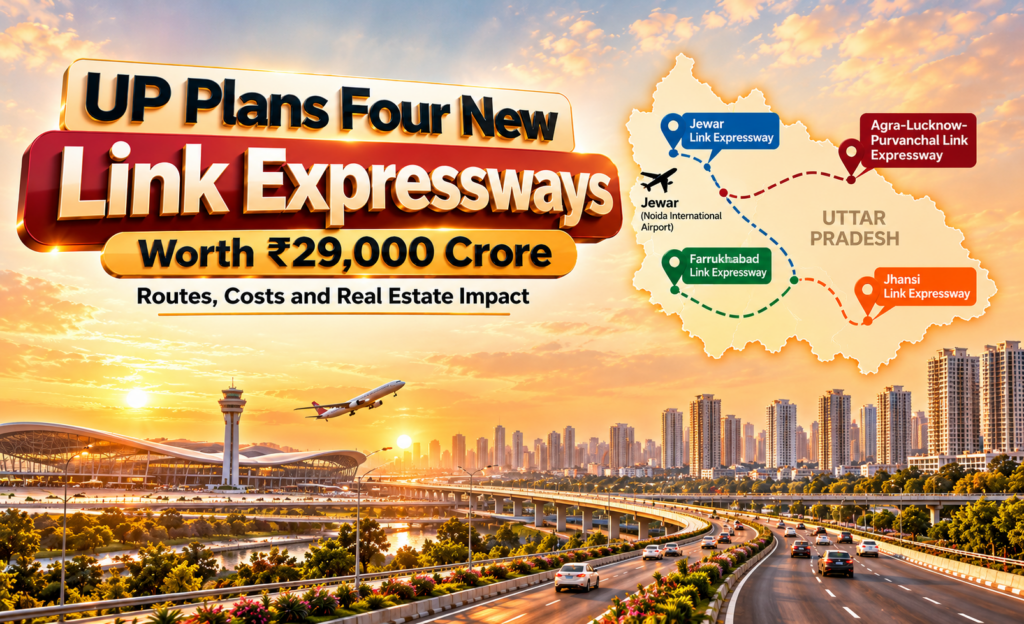
Uttar Pradesh is planning four new link expressways with an estimated investment of approximately ₹29,000 crore. The proposed corridors aim to improve connectivity between existing expressways, Noida International Airport at Jewar and important industrial regions. For property buyers and investors, the plan could influence the long-term development potential of several locations across the state.
Uttar Pradesh is continuing to expand its expressway network, with a new infrastructure push focused on connecting existing highways more efficiently.
According to recent reports published in October 2026, the Uttar Pradesh Expressways Industrial Development Authority (UPEIDA) has initiated steps to appoint independent engineers to monitor the progress, quality and technical compliance of four proposed link expressways.
The projects are expected to be developed over the next two to three years, subject to project execution and official timelines.
For the real estate sector, the key question is not simply how many kilometres of road will be constructed. It is how improved connectivity could support industrial investment, employment, logistics, housing demand and commercial development.
Key Highlights of UP’s ₹29,000 Crore Expressway Plan
Total proposed investment: Approximately ₹29,000 crore
Number of proposed link expressways: Four
Expected development period: Two to three years, as reported
Key infrastructure connection: Jewar Airport to the Ganga Expressway
Industrial focus: Bundelkhand, the Uttar Pradesh Defence Industrial Corridor and other economic regions
Monitoring authority: Uttar Pradesh Expressways Industrial Development Authority (UPEIDA)
The four proposed corridors are the Agra–Lucknow–Purvanchal Link Expressway, Jewar Link Expressway, Jhansi Link Expressway and Farrukhabad Link Expressway.
1. Jewar Link Expressway: A Key Development for the Noida–Yamuna Expressway Region
The proposed Jewar Link Expressway is among the most closely watched projects for the Delhi-NCR real estate market.
The corridor is planned to connect Noida International Airport at Jewar with the Ganga Expressway via Bulandshahr, strengthening the airport’s connection with Uttar Pradesh’s wider road network.
According to the reported project details, the proposed expressway is approximately 74.5 km long, with an estimated cost of ₹8,585.51 crore.
How could it influence real estate?
Improved connectivity between the airport, expressways and surrounding economic centres could support several forms of development:
Residential projects in locations with practical access to employment and transport infrastructure.
Commercial developments serving a growing population and business community.
Warehousing and logistics facilities benefiting from improved freight movement.
Industrial and institutional projects that require access to regional transport networks.
For the Noida, Greater Noida and Yamuna Expressway markets, this corridor is worth monitoring because of its connection to the wider airport-led development ecosystem.
However, the impact will depend on the final route, access points, construction progress, local infrastructure and actual economic activity.
What property buyers should watch: Verify the distance between a property and the planned interchange, confirm the project’s legal approvals, and assess existing demand before paying a premium based on future connectivity.
2. Agra–Lucknow–Purvanchal Link Expressway: Connecting Eastern and Western Uttar Pradesh
The proposed Agra–Lucknow–Purvanchal Link Expressway is intended to connect the Agra–Lucknow Expressway with the Purvanchal Expressway.
The reported project length is approximately 50 km, with an estimated investment of ₹4,775.84 crore.
The connection could create a more direct route between major expressway corridors and improve travel across several parts of Uttar Pradesh.
Potential real estate implications
Improved regional road connectivity may support:
Greater accessibility for towns connected to the expressway network.
More efficient movement of commercial goods.
Logistics and warehousing activity at suitable locations.
Residential and commercial development where employment and local services expand.
For investors, the important consideration is whether improved transport access translates into measurable economic activity.
Road connectivity alone does not guarantee that a particular locality will experience higher housing demand or property prices.
3. Jhansi Link Expressway: Strengthening Bundelkhand’s Industrial Connectivity
The proposed Jhansi Link Expressway is designed to improve connectivity for the Bundelkhand region, including the Bundelkhand Industrial Development Authority (BIDA) area and the Uttar Pradesh Defence Industrial Corridor.
The reported corridor is approximately 106.3 km long, with an estimated project cost of ₹7,968.30 crore.
The project forms part of the broader effort to connect industrial and developing regions with the state’s expanding expressway network.
What could this mean for the property market?
Industrial development can influence real estate demand through several channels:
Demand for industrial plots and manufacturing facilities.
Requirements for warehouses and distribution centres.
Housing demand from employees and supporting businesses.
Commercial opportunities for retail, hospitality and everyday services.
The scale of these opportunities will depend on industrial investment, employment creation, land-use permissions, utilities and the availability of supporting infrastructure.
For investors: Monitor actual industrial project approvals, construction activity and business operations instead of relying exclusively on future growth projections.
4. Farrukhabad Link Expressway: Improving Connectivity Across Central Uttar Pradesh
The proposed Farrukhabad Link Expressway is planned to connect the Ganga Expressway with the Agra–Lucknow Expressway through the Farrukhabad region, with the connection planned near Kudrail in Etawah district.
The reported length is approximately 90.8 km, with an estimated cost of ₹7,488.74 crore.
The corridor is intended to improve connectivity across central Uttar Pradesh and make travel between existing expressway routes more direct.
Potential benefits for regional development
The proposed link could support:
Better accessibility for towns along the connected transport network.
More efficient movement of agricultural and industrial goods.
Logistics and distribution activity in suitable locations.
Commercial development supported by local demand and employment.
For residential property buyers, improved connectivity may make certain locations more accessible. Nevertheless, schools, healthcare, public transport, utilities, job opportunities and overall liveability remain equally important factors.
5. Four Expressways at a Glance: Length and Estimated Cost
The following figures are based on the reported project details and remain subject to official project documentation and revisions.
| Proposed expressway | Approx. reported length | Estimated cost |
|---|---|---|
| Agra–Lucknow–Purvanchal Link | 50 km | ₹4,775.84 crore |
| Jewar Link Expressway | 74.5 km | ₹8,585.51 crore |
| Jhansi Link Expressway | 106.3 km | ₹7,968.30 crore |
| Farrukhabad Link Expressway | 90.8 km | ₹7,488.74 crore |
| Total | 321.6 km | ₹28,818.39 crore |
The combined reported project cost is approximately ₹28,818 crore, which explains the broader headline of an investment of around ₹29,000 crore.
These are proposed corridors and reported estimates, not confirmation that the entire network is already under construction or operational.
6. How Could the Four Expressways Shape Uttar Pradesh’s Real Estate Market?
Infrastructure investment can influence real estate by improving accessibility and supporting economic activity. The actual effect varies by location and property type.
A. Residential real estate
Better road connectivity can make some residential locations more practical for people commuting to workplaces or accessing regional centres.
Demand is more likely to be sustainable where connectivity is accompanied by employment opportunities, public services, schools, healthcare and organised urban development.
B. Commercial real estate
Improved access can support retail, hospitality, office and service-sector development where a sufficient customer base and business demand exist.
Commercial property performance will still depend on occupancy, rental demand, operating costs and the surrounding economic environment.
C. Industrial and logistics property
Expressways can improve freight movement between manufacturing centres, warehouses, distribution hubs and consumer markets.
Locations with suitable zoning, utilities, land availability and efficient interchange access may be better positioned to benefit.
D. Land and plotted developments
Infrastructure announcements can increase interest in land along proposed corridors. However, speculative demand can also create pricing risks.
Before buying land, investors should verify ownership, land-use classification, development permissions, acquisition notifications and the actual distance from approved access points.
E. Long-term regional development
Better connections between existing expressways may help integrate smaller towns and industrial regions into wider economic networks.
The long-term real estate impact will depend on whether this improved accessibility attracts businesses, jobs and sustained population demand.
7. What Does the Jewar Link Mean for Noida, Greater Noida and Yamuna Expressway?
For Delhi-NCR property buyers, the Jewar Link Expressway is the corridor most directly relevant to the region because it is planned to connect Noida International Airport with the Ganga Expressway.
Its significance should be considered alongside other infrastructure and development factors, including:
The operational and phased development status of Noida International Airport.
Existing connectivity through the Yamuna Expressway and Eastern Peripheral Expressway.
Industrial and institutional development in the wider region.
Local road access and planned interchanges.
Residential supply, affordability and end-user demand.
The airport and expressway network may support long-term regional economic growth. However, investors should distinguish between an announced project, a project under construction and an operational transport connection.
A property near a proposed expressway is not automatically a high-return investment. Its investment potential depends on the purchase price, legal status, local infrastructure, market demand and the time required for development to materialise.
8. Project Monitoring: Why Execution Matters
According to reports published on 22 October 2026, UPEIDA has initiated the process of appointing independent engineers to monitor the four link expressway projects.
These professionals are expected to help track construction quality, project milestones, technical compliance and implementation progress.
Independent monitoring is an important part of infrastructure delivery. However, appointing consultants or inviting tenders does not, by itself, mean that construction is complete or that a project is ready for public use.
For buyers and investors, the next important milestones include:
Confirmation of project approvals and final alignments.
Tendering and contractor appointments.
Land acquisition and construction progress, where applicable.
Development of access roads and interchanges.
Official commissioning and opening to traffic.
Following these milestones can help investors make better-informed decisions instead of acting solely on preliminary announcements.
9. Property Investment Checklist: What Buyers Should Verify
Before investing in a property on the expectation of future infrastructure-led growth, consider the following:
Location: Check the actual road distance to the proposed corridor and its access points.
Legal due diligence: Verify ownership, approvals and applicable RERA registration requirements.
Development status: Confirm whether the infrastructure is proposed, approved, under construction or operational.
Local amenities: Assess water, electricity, healthcare, schools and public transport.
Market demand: Review comparable transactions, rental demand and unsold supply.
Pricing: Compare the asking price with similar properties and realistic local demand.
Investment horizon: Consider whether the expected development timeline matches your financial plans.
These checks are particularly important when evaluating land, plotted developments and under-construction residential projects marketed around future infrastructure.
Conclusion: A Major Infrastructure Plan to Watch
Uttar Pradesh’s proposed ₹29,000 crore investment in four new link expressways represents a significant plan to strengthen regional road connectivity.
The four corridors are intended to connect existing expressways, improve access to industrial regions and establish a link between Noida International Airport and the Ganga Expressway.
For real estate, the potential implications extend across residential housing, commercial development, logistics, warehousing and industrial property.
The Jewar Link Expressway is particularly relevant to the Noida, Greater Noida and Yamuna Expressway region, while the other corridors could support improved accessibility and economic development in their respective areas.
Ultimately, infrastructure can create opportunities, but sustainable property growth depends on execution, employment, local demand and responsible investment decisions.
For buyers and investors, the best approach is to follow official project updates, verify property credentials and assess the fundamentals of each location before committing capital.
At Aditya Estates, we believe that understanding infrastructure developments is an important part of making informed real estate decisions across Noida, Greater Noida and the Yamuna Expressway region.
Stay informed, evaluate the facts and make property decisions based on verified information rather than speculation.
Sources Checked
Send us your property requirement
Prefer not to call? Complete the form and the Aditya Estates team will contact you.
Categories
Tags
affordable housing
Central Noida
Commercial leasing
Delhi NCR
Delhi NCR property
Family Living
Faridabad real estate
Greater Noida
Greater Noida industrial development
Greater Noida real estate
Greater Noida West
Gurgaon
Gurugram
Homebuyer
Homebuyer guide
Homebuying
Infrastructure
Investor Guide
Jewar Airport
Legal Checks
Luxury Homes
New Launch
Noida
Noida commercial real estate
Noida Expressway
Noida International Airport
Noida investment
Noida Property
Noida property investment
Noida Real Estate
Premium housing
Property comparison
Property Documents
Property Investment
Registration Charges
Rental yield
RERA
Resale flats
Retail property
Sector 150 Noida
Stamp Duty
UP RERA
Yamuna Expressway
Yamuna Expressway real estate
YEIDA