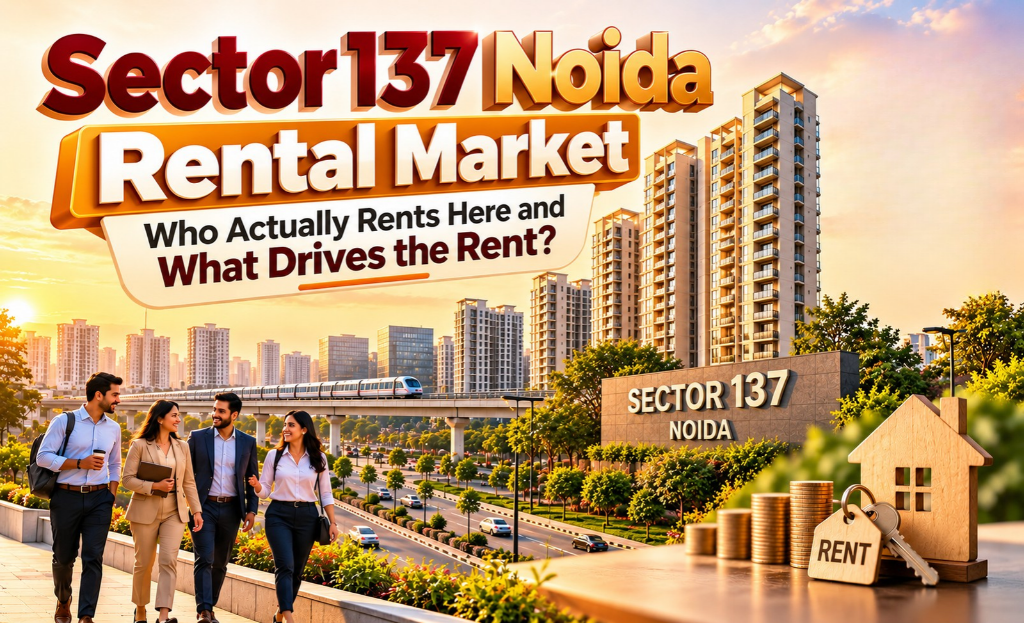
The short answer is that the Sector 137 Noida rental market is shaped less by brochure-led luxury demand and more by practical end users: office commuters, couples, small families and some shared-accommodation seekers who want a gated flat close to the Noida Expressway employment belt. That fits the wider Noida pattern, because the expressway sectors from 125 to 135 are an established office corridor, and Sectors 128, 132, 135 and 137 mix group housing with office and institutional land.
For a landlord or investor, that matters because rent in this micro-market is usually supported by daily usability rather than by a pure prestige premium. In plain terms, tenants here are likely to pay for shorter commute time, functional society amenities, security, lift reliability, parking clarity and ready access to metro and expressway routes. They are less likely to choose a unit only because of marketing language around lifestyle.
Current research evidence gives a limited but useful snapshot. One market tracker says that as of June 2026, the average rental rate in Sector 137 is ₹29 per sq ft and the locality shows a rental yield of 3.30%. Another portal shows an average rent of ₹16,300 per month for a 2 BHK in Sector 137. These are portal-level market indicators, not transaction-certified figures, so use them as directionally useful estimates rather than fixed quoting benchmarks.
If you are pricing, buying for rent, or assessing vacancy risk, the right question is not only “what is the average rent?” but “which tenant profile is most likely to take my specific flat?” That depends on layout, furnishing, tower reputation, maintenance quality and the society’s everyday livability.
Who rents in Sector 137 Noida
Based on the sector’s location and the available evidence, Sector 137 appears to attract a commute-sensitive tenant base rather than a purely destination-led one.
1) Working professionals in the expressway office belt
This is the most logical core segment. The background evidence identifies the Sector 125 to 135 expressway belt as one of Noida’s leading office micro-markets. Sector 137 sits within that wider expressway ecosystem, so renters who work in nearby offices can reasonably value shorter travel time over a more central but farther location.
Why this matters for landlords: A professionally managed 2 BHK or compact family unit often fits this segment better than an oversized apartment with a high carrying cost. These tenants usually compare rent against commute savings and society quality, not just carpet area.
2) Couples and small families seeking gated community living
Sector 137 is a group-housing-led area, which typically suits tenants who want organised entry, lifts, security staff, shared open areas and resident services. Families renting here are likely to prioritise practical features such as children’s play areas, power backup, cleanliness, and the condition of common areas.
Why this matters for landlords: Family tenants usually examine the society as closely as the flat. If the tower lobby, lifts, parking and maintenance desk feel neglected, a rent ask that looks fair on paper may still face resistance.
3) Shared renters and co-living or PG demand at the budget end
There is also evidence of PG, hostel and co-living inventory being marketed in Sector 137. That does not prove dominant demand, but it does confirm that the sector is seen as viable for longer-stay shared accommodation.
Why this matters for landlords: If your unit is compact, efficiently planned and close to daily transport links, it may appeal either to a standard family tenant or to unrelated sharers, subject of course to society rules and lease terms. Always confirm whether the society permits the intended occupancy model, because a mismatch can create disputes after move-in.
What tenants in this sector are actually paying for
In a market like Sector 137, rent is usually a mix of location utility, society performance and flat readiness. These are the factors most likely to affect achievable rent.
Commute convenience
Proximity to the Noida Expressway and access to the wider office belt are central demand drivers. Even where two sectors look similar online, the one with easier daily travel often lets faster.
Why you should check this: Commute convenience supports occupancy. A flat that leases quickly can outperform a nominally higher-rent unit that sits vacant for weeks.
Society maintenance quality
The primer is clear that maintenance levels can differ sharply between societies, and that buyers and landlords should ask how maintenance is billed and what reserves exist for major repairs. Tenants notice this immediately in lift uptime, corridor condition, water systems and security response.
Why you should check this: Net rental performance depends on retention as much as headline rent. A poorly maintained society can increase tenant turnover and force repeated repainting, brokerage and vacancy loss.
Usable amenities, not brochure amenities
For this tenant base, a gym, children’s play space, parking, power backup and clean common areas usually matter more than symbolic luxury. The market is likely to reward amenities that improve everyday routine.
Why you should check this: Landlords often overvalue decorative upgrades inside the flat and undervalue the society’s practical amenities. In tenant decision-making, the second set may matter more.
Furnishing and move-in readiness
A standard residential let in NCR is often unfurnished or lightly furnished, but move-in readiness still affects rentability. Functional wardrobes, working lights, curtains or blinds, fans, geysers and a clean kitchen can widen the tenant pool.
Why you should check this: A modest spend on useful fit-outs can reduce vacancy, while expensive aesthetic work may not produce matching rent. The test is whether the improvement solves a tenant’s immediate move-in problem.
What current rent evidence suggests
Because the supplied research is limited and comes from property portals, the figures below should be read as market estimates, not guaranteed transaction values.
| Indicator | Figure in research | What it means |
|---|---|---|
| Average rental rate | ₹29 per sq ft as of June 2026 | A portal-level estimate for the locality, useful for broad comparison only |
| Rental yield | 3.30% | A portal estimate of gross rental yield, not a net return figure |
| Average 2 BHK rent | ₹16,300 per month | An indicative locality average from a property portal, not a society-specific quote |
These numbers are useful only when combined with property-specific realities. A higher floor, better facing, stronger tower reputation, cleaner interiors or superior furnishing can change achievable rent within the same project. The editorial primer also notes that even within one project, floor, facing, tower and position affect pricing.
For investors, the practical takeaway is this: do not underwrite a purchase using a sector average alone. Compare your flat with recent listings and, more importantly, with units in the same society that match on size, furnishing and tower quality. If you need help assessing where a unit sits in the resale-versus-rental spectrum, contextual market assistance is more useful than a generic portal average; that is where a local operator’s rent or leasing services process can help organise pricing, screening and documentation.
How landlords should evaluate a Sector 137 flat before setting rent
- Check the society’s maintenance standards. Ask about lift servicing, water supply, common area upkeep and reserve planning for major repairs. This matters because recurring breakdowns directly weaken tenant retention.
- Check total occupancy cost, not only rent. Clarify how maintenance is charged and whether parking or other services add to the monthly outgo. This matters because tenants compare all-in monthly cost, not headline rent in isolation.
- Check the flat’s move-in condition. Record the condition of walls, woodwork, bathrooms, fittings and appliances. This matters because ready units lease faster and create fewer move-in disputes.
- Check whether your likely tenant is a family, a couple or sharers. Match the furnishing and lease structure accordingly. This matters because the wrong product-positioning can leave the flat vacant even when the asking rent looks reasonable.
- Check society rules on occupancy and leasing. Confirm rules on shared accommodation, tenant registration, pets, parking and service staff access. This matters because a lease that conflicts with society norms can create friction and early exit risk.
- Check tenant identity and complete police verification where applicable. The background primer specifically recommends identity verification and written inventory recording. This matters for security, recovery and smoother dispute handling.
- Check inventory in writing. List fixtures, appliances, keys, remotes and any existing wear and tear. This matters because it reduces deposit disputes when the tenant vacates.
- Check whether the lease term should be eleven months or a registered longer lease. The primer notes that leases of one year or more must be registered. This matters because paperwork, enforceability and cost change with lease duration.
What investors should be careful about
The biggest mistake in this micro-market is to mistake rental activity for uniform rental strength. A sector can be active yet still have wide variation between projects and even between towers.
Confirmed fact: Sector 137 sits in the Noida Expressway belt, where residential stock interacts with nearby office and institutional land uses.
Estimate from portal research: The locality average rental rate is ₹29 per sq ft, rental yield is 3.30%, and average 2 BHK rent is ₹16,300 per month.
Opinion based on the evidence: The most resilient demand in Sector 137 is likely to come from practical renters who value commute efficiency and functioning gated-community living more than premium branding alone.
That means investors should be cautious about assuming every apartment in the sector will command the same rent trajectory. A unit in a better-run society may hold occupancy better than a superficially similar one in a weaker-maintenance project.
Where to verify official facts before you buy or lease
If you are moving from rental analysis to an actual purchase or long-term holding decision, verify project and authority details on official pages rather than relying only on listing portals. Use the Noida Authority official portal for local authority functions and records relevant to Noida properties. If a project requires regulatory disclosure or you need registration details, verify them on the applicable state RERA portal separately.
This step matters because portal rent data may help with market reading, but only official and project-level records help you confirm the legal and administrative position of the asset you plan to hold.
Bottom line
The Sector 137 Noida rental market appears to be driven mainly by working professionals, couples, small families and some shared-accommodation demand. In this micro-market, tenants are usually paying for commute convenience, society reliability, usable amenities and move-in readiness more than for brochure language.
For an investor, the practical edge lies in understanding the real tenant profile of a specific tower and flat. Use sector averages as a starting point, but let your final pricing and purchase logic depend on society maintenance, occupancy cost, unit condition and the actual renter segment most likely to lease your apartment.
Frequently asked questions
Who is the typical tenant in Sector 137 Noida?
The most likely tenant profile is working professionals, couples and small families who want a gated apartment near the Noida Expressway office belt. There is also some evidence of PG and co-living activity, which suggests budget and shared-stay demand in parts of the sector.
What rent level does current research indicate for Sector 137?
The supplied portal research indicates an average rental rate of ₹29 per sq ft as of June 2026 and an average 2 BHK rent of ₹16,300 per month. These are market estimates from property portals, so they should be verified against current listings and actual society-level leasing activity.
What amenities matter most to tenants here?
In this micro-market, practical amenities usually matter most: security, lift reliability, parking, power backup, clean common areas and overall society maintenance. These features affect daily life directly, so they can influence occupancy and tenant retention more than cosmetic luxury positioning.
Is Sector 137 mainly a family rental market or a bachelor market?
It appears to lean toward standard apartment renters such as professionals, couples and small families, because it is a group-housing-led expressway location. However, the presence of PG and co-living listings suggests that some shared accommodation demand also exists, subject to society rules.
What should a landlord verify before leasing a flat in Sector 137?
A landlord should verify tenant identity, complete police verification where applicable, record a written inventory and confirm society rules on occupancy and parking. These checks matter because they reduce security risks, deposit disputes and the chance of a lease structure that conflicts with society norms.
Sources checked
Send us your property requirement
Prefer not to call? Complete the form and the Aditya Estates team will contact you.