Aditya Estates, based in Noida Sector 18 in the Delhi NCR region > Blog > Infrastructure > Yamuna Expressway: Infrastructure-Led Opportunities Shaping the Next Real Estate Growth Corridor
Yamuna Expressway: Infrastructure-Led Opportunities Shaping the Next Real Estate Growth Corridor
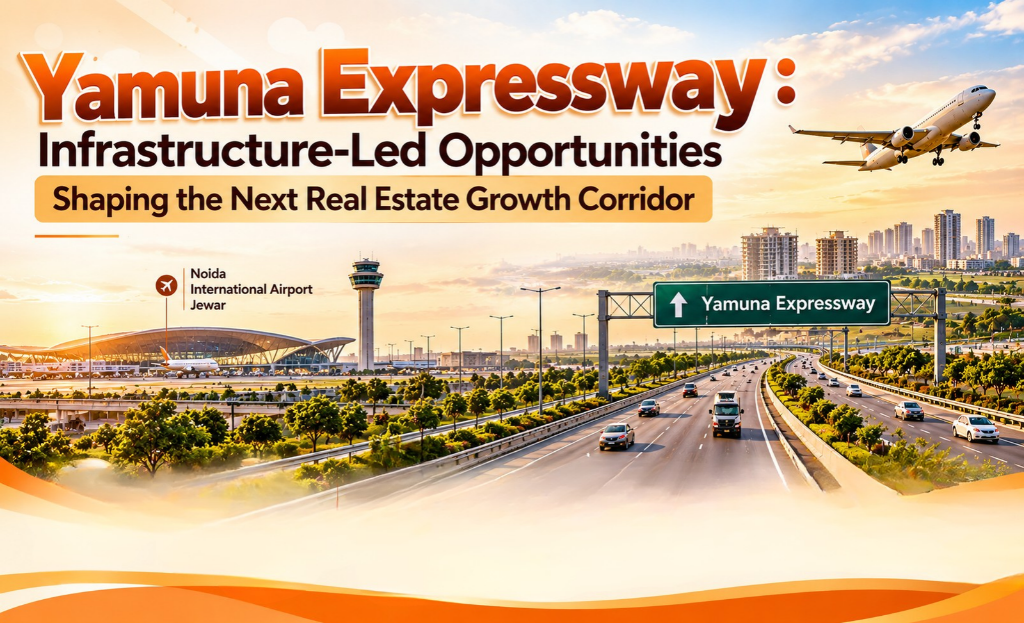
Real estate growth is often driven by a combination of connectivity, employment, infrastructure and urban development. Along the Yamuna Expressway, these factors are coming together to shape an emerging economic and real estate corridor in Uttar Pradesh.
Stretching from Greater Noida towards Agra, the Yamuna Expressway region is attracting attention from residential buyers, industrial businesses, logistics operators and long-term property investors.
The most significant change is the region’s transition from a primarily land-and-plot investment destination towards a broader economic ecosystem supported by aviation, manufacturing, warehousing, institutional development and planned urban infrastructure.
With Noida International Airport at Jewar commencing commercial flight operations on 15 June 2026, the region has entered an important new phase. The airport’s long-term impact will depend on its expansion, connectivity, passenger and cargo activity, and the pace at which supporting businesses establish operations.
1. Jewar Airport: A Major Infrastructure Catalyst
Noida International Airport is one of the most important infrastructure developments influencing the Yamuna Expressway region.
The airport creates the potential for new economic activity across several sectors, including:
Aviation and airport-related services
Cargo handling and air-freight logistics
Hotels, hospitality and business accommodation
Warehousing and distribution
Commercial offices and support services
Housing for professionals and employees
Airport-led development can create demand for multiple property categories. However, the benefits do not necessarily reach every location equally. Properties with practical road connectivity, suitable land use, reliable utilities and proximity to actual employment centres may be better positioned to benefit.
For investors, the important question is not simply how close a property is to the airport, but whether it is well connected to the economic activities the airport generates.
2. Expressway Connectivity: The Foundation of Regional Growth
Connectivity remains one of the strongest factors influencing real estate demand.
The Yamuna Expressway connects the Greater Noida region with Agra, while its wider network of roads and proposed transport links is intended to improve access to other parts of the National Capital Region.
The Eastern Peripheral Expressway–Yamuna Expressway interchange is another important connectivity project. It is intended to improve movement between the two expressways and strengthen access towards the Jewar airport region. Investors should verify its current operational status before relying on any assumed travel-time benefit.
In March 2026, the Union Cabinet also approved a revised project cost of approximately ₹3,630.77 crore for a 31.42-km greenfield connection linking the Delhi–Faridabad–Ballabhgarh–Sohna spur of the Delhi–Mumbai Expressway with Jewar Airport. This is a significant regional connectivity initiative. Its ultimate real estate impact will depend on construction progress, completion and actual traffic patterns.
What does this mean for real estate?
Improved connectivity can strengthen the commercial viability of industrial land, logistics facilities, residential communities and business-support services. Yet, announced infrastructure should be distinguished from infrastructure that is completed and operational.
3. Industrial Development: The Employment-Driven Opportunity
One of the most important long-term drivers of the Yamuna Expressway region is its planned industrial ecosystem.
The Yamuna Expressway Industrial Development Authority (YEIDA) identifies several industrial and specialised development zones, including:
Semiconductor and Electronics Manufacturing Cluster
Medical Devices Park
Data Centre Park
Apparel and MSME parks
Toy and handicraft-related industrial development
Logistics and warehousing infrastructure
These projects are intended to diversify the regional economy beyond residential real estate. YEIDA’s industrial development plans provide the framework for a wider manufacturing and business ecosystem.
Industrial investment can influence the property market through employment generation, vendor networks, transportation requirements and demand for worker and professional accommodation.
For residential investors, this creates a useful principle: look for the relationship between planned employment centres and housing demand, rather than relying on infrastructure announcements alone.
The pace of real demand will depend on land allotments, approvals, factory construction, business operations and actual job creation.
4. Logistics and Warehousing: An Emerging Commercial Segment
As aviation, manufacturing and regional connectivity expand, logistics infrastructure becomes increasingly important.
YEIDA has proposed a multimodal logistics park at Tappal-Bajna, intended to support road-and-rail transport integration, warehousing and value-added logistics services.
Potential property opportunities in this segment include:
Industrial sheds and factory premises
Warehousing and distribution facilities
Transport and fleet-support facilities
Industrial plots in appropriately designated zones
Commercial facilities serving logistics and manufacturing businesses
Unlike residential property, logistics investments require detailed assessment of road access, permitted land use, truck movement, power supply, loading facilities and proximity to customers or transport infrastructure.
Investors should also distinguish between land that is legally approved for industrial or logistics use and residential plots that are being marketed with speculative claims about future commercial development.
5. Film City and Institutional Development: Building a Wider Economic Ecosystem
The proposed International Film City in Sector 21 is another major development associated with the Yamuna Expressway region.
If developed and operationalised as planned, a large entertainment and media destination could support demand for production facilities, hospitality, commercial services, food and beverage businesses, and associated employment.
The wider planned urban development strategy also envisages residential, commercial, institutional and recreational uses. YEIDA’s Master Plan 2041 describes a planned greenfield urban region linked to the airport and economic corridors.
For real estate investors, such projects are worth monitoring—but the stage of development matters. A project announcement, land allotment, construction commencement and operational launch represent very different levels of certainty.
The investment case becomes stronger when supporting businesses, employment and transport infrastructure begin functioning, rather than when expectations are based solely on proposed plans.
6. Where Are the Potential Real Estate Opportunities?
Different investors may find different opportunities along the Yamuna Expressway corridor.
A. Residential plots
Residential plots may appeal to buyers seeking flexibility in future construction or a long-term holding strategy.
Before investing, check the exact sector, approved layout, allotment conditions, title, lease terms, development charges, possession status and applicable transfer rules.
B. Apartments and group housing
Apartments may suit end-users who want a planned residential community, as well as investors looking for potential future rental demand.
Evaluate actual construction progress, possession timelines, developer credentials, maintenance costs, nearby employment centres and current residential occupancy.
C. Industrial plots and manufacturing facilities
Businesses may explore industrial properties aligned with the area’s developing manufacturing ecosystem.
Land-use classification, statutory approvals, power and water availability, environmental requirements and the intended business activity are critical considerations.
D. Commercial property
Retail spaces, offices and service-oriented commercial units may benefit as population and employment expand.
However, commercial viability depends on the size of the local catchment, footfall, tenant demand, accessibility and the property’s actual operating environment.
E. Warehousing and logistics
This segment may suit investors and operators with an understanding of industrial property requirements.
Access to transport corridors, operational permissions, infrastructure readiness and realistic rental assumptions should be assessed before committing capital.
7. Is the Yamuna Expressway the Right Investment for You?
There is no single answer for every investor. The right property depends on your budget, investment horizon, liquidity needs and risk tolerance.
| Investor profile | What to evaluate |
|---|---|
| First-time property buyer | Legal clarity, affordability and genuine end-use demand |
| Long-term plot investor | Location, approved land use, holding costs and development timelines |
| Residential investor | Occupancy, rental demand, possession and maintenance |
| Business owner | Industrial approvals, utilities, road access and operating costs |
| Commercial investor | Tenant demand, rental yield, vacancy risk and exit liquidity |
Investors should calculate the complete acquisition cost, including stamp duty, registration, applicable taxes, lease rent, maintenance, financing costs and any development charges.
It is also important to compare the property’s total cost with comparable transactions and realistic rental or resale scenarios.
8. Risks Investors Should Not Ignore
Infrastructure-led development can create opportunities, but it does not eliminate real estate risk.
Important checks before investing:
Verify legal status: Confirm title, allotment documents, approvals and the property’s permitted use.
Check the authority: Determine whether the property falls under YEIDA or another relevant development authority, and verify the applicable rules.
Confirm project progress: Separate completed infrastructure from proposed, approved or under-construction projects.
Assess genuine demand: Look for operational businesses, employment, occupied housing and actual transactions.
Avoid guaranteed-return claims: No infrastructure project guarantees appreciation or a particular resale price.
Plan for holding costs: Development may take longer than expected, and vacant property can remain illiquid.
Use independent due diligence: Obtain legal and financial advice before making a substantial investment.
A disciplined investor studies both the growth potential and the time required for that potential to translate into measurable property demand.
9. The Long-Term Outlook: From Land Investment to an Economic Corridor
The Yamuna Expressway region’s long-term story is increasingly linked to the interaction between transport infrastructure, aviation, industrial activity, logistics and planned urban development.
The airport provides an important operating milestone. Expressway connectivity projects may improve regional access, while industrial and logistics developments could create a broader base of economic activity.
Over time, the most sustainable real estate demand is likely to depend on whether these developments translate into businesses, jobs, population growth and functional urban infrastructure.
This is why investors should focus on location quality, legal certainty, development progress and actual demand rather than treating the entire Yamuna Expressway corridor as one uniform market.
Conclusion: Invest in the Growth Drivers, Not Just the Headlines
The Yamuna Expressway deserves attention as a developing real estate and economic corridor, supported by airport operations, regional connectivity initiatives and planned industrial infrastructure.
For buyers and investors, the opportunity lies in identifying properties that are legally sound, appropriately located and aligned with real economic demand.
The most effective strategy is to match the property category with your investment horizon, verify the facts independently and make decisions based on evidence rather than speculation.
At Aditya Estates, we believe informed property decisions begin with understanding the infrastructure, the location and the fundamentals behind the investment.
Whether you are exploring residential plots, apartments, commercial property or industrial opportunities across Noida, Greater Noida and the Yamuna Expressway region, careful research and location-specific due diligence should come first.
Disclaimer: This article is for general information only and does not constitute investment, legal or financial advice. Infrastructure schedules, project approvals and property-market conditions can change. Verify current information with the relevant authorities and qualified professionals before investing.
Send us your property requirement
Prefer not to call? Complete the form and the Aditya Estates team will contact you.
Categories
Tags
affordable housing
Central Noida
Commercial leasing
Delhi NCR
Delhi NCR property
Family Living
Faridabad real estate
Greater Noida
Greater Noida real estate
Greater Noida West
Gurgaon
Gurugram
Homebuyer
Homebuyer guide
Homebuying
Infrastructure
Investor Guide
Jewar Airport
Legal Checks
Luxury Homes
New Launch
Noida
Noida International Airport
Noida investment
Noida micro-market
Noida Property
Noida Real Estate
Premium housing
Property comparison
Property Documents
Property Investment
Registration Charges
Rental yield
RERA
Resale flats
Resale property
Retail property
Sector 128
Sector 137
Sector 150 Noida
Stamp Duty
UP RERA
Yamuna Expressway
Yamuna Expressway real estate
YEIDA